Trump Accounts Go Live Tomorrow: What to Know

A new federally created savings account for American children will launch on July 4, 2026, when Trump Accounts will begin accepting contributions. These accounts were formally established under Section 530A of the Internal Revenue Code as part of the One Big Beautiful Bill Act.

Whether you have a newborn, a teenager, or grandchildren across multiple ages – we thought it might be helpful to give you an overview of what the accounts actually do, what they do not do, and how to think about them alongside what you may already have in place for the children in your life. This new account type has certain limitations and decisions that will depend on your family’s situation and goals.

What Are Trump Accounts, Exactly?

Trump Accounts were created for any child under 18 who has a valid Social Security Number and U.S. citizenship. The account is held in the child’s name, with a parent or guardian serving as custodian until the child turns 18, at which point the account is treated like a traditional IRA under standard IRS rules.1

For U.S. citizens born between January 1, 2025, and December 31, 2028, the federal government will make a one-time $1,000 contribution, called the pilot program payment — into children’s Trump Accounts to help kick-start their savings.1
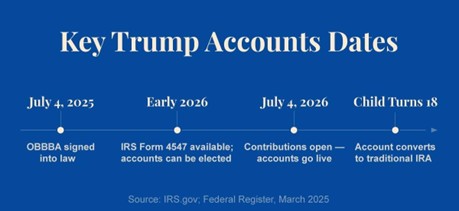
Who Receives the $1,000 Federal Seed — and Who Does Not

The seed money is a detail that may be confusing, so it is worth stating clearly.

Children born between January 1, 2025, and December 31, 2028, who are U.S. citizens, may be eligible for Trump Accounts—and a one-time $1,000 federal pilot contribution deposited directly by the U.S. Treasury.

There are no income requirements to receive this contribution, meaning it is available regardless of family income. The election is made on IRS Form 4547.

By completing this form you’ll be modifying your tax return, and you are encouraged to consult your tax, legal, or accounting professional if you want to move ahead with a Trump Account.

Children born before January 1, 2025, do not receive the federal $1,000 seed. However, they may still open a Trump Account with all other features intact, provided they are under age 18 and have a valid Social Security Number. For families with older children, the account may still make sense as a supplemental vehicle, even without the seed contribution.

What Other Entities Are Making Contributions

The Treasury has announced that dozens of companies are prepared to match their employee contributions to their children’s accounts in various ways. Some companies have stepped up and said they are going to contribute to the accounts, and some others have said they will make contributions as part of their philanthropic initiatives. Taken together, these additional contributions may start to add up.2,3

This contribution is separate from the federal program and has its own eligibility process. Families in qualifying areas should monitor updates from the Invest America Council for details as they are finalized.

How Account Contributions Work

Once a Trump Account is open, here is who can contribute and how:4

  • Parents, family members, friends, and the child themselves may contribute up to $5,000 per year, combined. This limit will be indexed for inflation starting in 2027.
  • Employers may contribute up to $2,500 per year to an employee’s account or the account of the employee’s dependent. Employer contributions count toward the $5,000 annual limit.
  • Governmental entities, state programs, and eligible 501(c)(3) charitable organizations may make qualified general contributions to a class of beneficiaries, such as all children born in a given year within a state or county. These contributions do not count against the $5,000 individual limit.
  • There is no earned income requirement for the child. Contributions are after-tax (not deductible) for individual contributors.

One important tax distinction: Individual contributions from parents, family, and the child are made with after-tax dollars and are generally not taxable upon withdrawal. The federal seed, employer contributions, and charitable program contributions are treated as pre-tax and will be taxable as ordinary income when withdrawn.

This article goes over high-level information. Your tax professional can speak to your unique tax situation.

Where the Money Can Be Invested

There are constraints on where the assets in Trump Accounts can be invested. Account funds must be invested in low-cost U.S. equity index funds or exchange-traded funds. The law imposes a fee cap of 0.10% (10 basis points) annually.5

What that means in practice: Funds are concentrated in U.S. stock market exposure, without access to international equity, fixed income, real assets, or other asset categories. For an 18-year time horizon, a U.S. equity index allocation has historically performed well. The potential lack of asset class diversification and the presence of more conservative options within the account are factors families and their financial professionals should consider in the broader picture.

Exchange-traded funds are sold only by prospectus, which will provide more detail on the risks, expenses, and investment objectives. We encourage you to read the prospectus carefully. Asset allocation and diversification are approaches to help manage investment risk. Asset allocation does not guarantee against investment loss.

How Much Could Your Child’s Account Be Worth Before They Graduate High School?

What is the “Growth Period” of an Account?

The “growth period” for the beneficiary of a 530A account begins when the initial Trump Accounts were established and ends on December 31 of the calendar year in which the account beneficiary attains age 17. Generally, distributions from Trump Accounts are not allowed during the growth period.5

What Happens When the Child Turns 18?

At the end of the calendar year in which the child turns 17, the growth period officially closes. From that point forward, the account operates as a traditional IRA under standard IRS rules, and the child takes full ownership.

Penalty-free uses after age 18 follow traditional IRA exception rules, which include:

  • Qualified higher education expenses (tuition, fees, required books, room, and board)
  • First-time home purchase, up to $10,000 lifetime
  • Withdrawals after reaching age 59½ for retirement
  • Other traditional IRA exceptions under IRS rules (disability, certain medical expenses, etc.)

Once you reach age 73, you must begin taking the required minimum distributions from a traditional IRA in most circumstances. Withdrawals from traditional IRAs are taxed as ordinary income and, if taken before age 59½, may be subject to a 10% federal income tax penalty.

There is also no requirement to use the funds for a specific purpose—the child may withdraw for any reason upon turning 18, though taxes and potential penalties would apply.

This last point is worth flagging in family conversations. Unlike a 529 account, which is structured specifically around education spending, Trump Accounts do not legally restrict the beneficiary’s access once they reach 18. Parents and grandparents contributing with specific goals in mind should factor this into their overall strategy.6

A 529 plan is a tax-advantaged education savings plan. Before choosing a plan, it’s important to consider not only the state tax treatment – but also any associated fees and expenses.6

How Trump Accounts Compare to Other Savings Vehicles

While Trump Accounts are a new tool, they are not meant to replace existing ones. How they stack up depends on what your family is trying to accomplish.
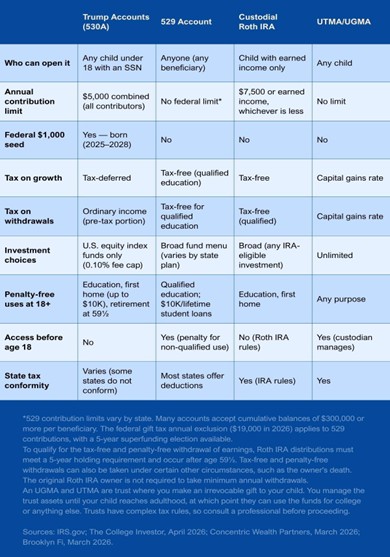
If education funding is your primary goal, you might want to consider a 529 account because of its tax-free growth and tax-free withdrawals for qualifying education expenses. If the goal is to focus on the future with flexibility beyond college, then Trump Accounts may play a role.

State Tax Conformity: An Important Variable

Federal tax treatment is only part of the picture. States are not required to conform to federal tax rules, and some do not. California, for example, does not currently conform to Section 530A. Families in non-conforming states may face state income tax on deferred federal growth. This is an area where guidance is still evolving and where involving a tax professional can help.

What to Do Right Now

The most time-sensitive action for families with children born in 2025 or 2026 is establishing the account and making the pilot program election to pursue the federal $1,000 contribution. Here is a checklist to consider:5

  • If your child was born in 2025: File IRS Form 4547 through Trumpaccounts.gov.
  • Contributions can begin after July 4, 2026.
  • If your child was born in 2026 or later through 2028, file Form 4547 at any time before December 31 of the year the child turns 17.
  • If your child was born before 2025 and is under 18, an account can still be opened without the federal seed.
  • Regardless of birth year: Confirm your state’s tax conformity with Section 530A before making substantial contributions.
  • Revisit your existing strategy: If you already have a 529 account, the Trump Accounts may work alongside it.

A Few Cautions

New account types take time for implementation guidance to settle fully. As of July 2026, several aspects of Trump Accounts are confirmed in statute, but IRS regulations are still being finalized. Key areas of ongoing guidance include specific eligibility verification procedures for the federal seed, gift tax treatment for contributions (particularly for grandparents), and final confirmation of withdrawal rules and penalties as they interact with traditional IRA frameworks.

Good recordkeeping matters from the start. Track the source of every contribution separately, because personal after-tax contributions and government or employer pre-tax contributions are taxed differently on withdrawal. Mixing records may complicate your tax strategy down the road.

If you’re considering Trump Accounts, a financial professional may offer some insights. The rules are real, the benefits are real, and the decisions about how to incorporate Trump Accounts into a broader savings strategy are genuinely individualized.

Frequently Asked Questions

Can Grandparents Contribute to Trump Accounts?

Yes. A parent, guardian, grandparent, or adult sibling can make an election for an eligible child and file Form 4547 on their behalf. Grandparents can also contribute to the account once it is open, subject to the $5,000 annual combined limit that applies across all contributors. The accounts are well-suited to multigenerational giving, but coordinating contribution amounts across family members matters.8

What Happens to Trump Accounts if My Child Does Not Go to College?

The account does not require an educational purpose. After the child turns 18, the account behaves like a traditional IRA, and penalty-free withdrawals are available for qualified higher education expenses, a first-time home purchase up to $10,000, or retirement after reaching age 59½. For any other use before 59½, withdrawals are subject to ordinary income tax plus a 10% early withdrawal penalty on the taxable portion.9

Can My Child Have Both Trump Accounts and a 529 Account?

Yes. There is no rule preventing a family from maintaining both Trump Accounts and a 529 account simultaneously. The two accounts might serve different purposes: A 529 account for education spending with tax-free qualified withdrawals, while Trump Accounts can be used for other things. 10

Should I Open a Trump Account Even if I Already Maxed Out a 529 Account?

It depends on your goals and tax situation, but the $1,000 federal seed for children born 2025 through 2028 is a straightforward reason to establish the account. If your child is eligible for the federal $1,000 contribution, filing Form 4547 online takes little time and costs nothing.7

Is There a Deadline to Claim the $1,000 Federal Contribution?

The last day to make a pilot program election for an eligible child is December 31 of the calendar year in which the child reaches age 17.5

For children born in 2025, the election can be made with the 2025 tax return or through TrumpAccounts.gov, and the earlier the account is established, the longer the $1,000 has the opportunity to grow before the child turns 18.

Interested in setting up a time to talk about financial planning for your family? Contact First Financial’s Investment & Retirement Center

Securities and advisory services are offered through LPL Financial (LPL), a registered investment advisor and broker/dealer (member FINRA/SIPC). Insurance products are offered through LPL or its licensed affiliates. First Financial Federal Credit Union (FFFCU) and First Financial Investment & Retirement Center are not registered as a broker/dealer or investment advisor. Registered representatives of LPL offer products and services using First Financial Investment & Retirement Center, and may also be employees of FFFCU. These products and services are being offered through LPL or its affiliates, which are separate entities from and not affiliates of FFFCU or First Financial Investment & Retirement Center.

Securities and insurance offered through LPL or its affiliates are:

This content is for informational and educational purposes only and does not constitute tax, legal, or investment advice. Trump Accounts rules are subject to ongoing IRS guidance. Consult a qualified tax advisor or financial professional before making decisions based on this content. Projected growth figures are hypothetical and illustrative only; past performance of any index does not guarantee future results. Copyright FMG Suite.

A 529 plan is a tax-advantaged education savings plan. Before choosing a plan, it’s important to consider not only the state tax treatment but also any associated fees and expenses. Availability of a state tax deduction will depend on your state of residence, as state tax laws and treatment may vary from federal tax laws. If you make nonqualified distributions, earnings will be subject to income tax and a 10% federal penalty tax.

Sources:

1. Investor.gov, April 2026
2. BusinessWire.com, January 29, 2026
3. APNews.com, December 2, 2025
4. IRS.gov, December 2, 2025
5. GovInfo.gov, March 9, 2026
6. PKFOD.com, April 2026
7. BrooklynFI.com, February 20, 2026
8. MilestoneFinancialPlanning.com, March 26, 2026
9. Knowledge.DLAPiper.com, March 30, 2026
10. ConcentricWealthPartners.com, March 6, 2026


Business Loan vs. Business Line of Credit: What’s the Difference?

Running a business often requires access to funding. Whether you’re purchasing equipment, expanding your operations or managing seasonal cash flow fluctuations – having the right financing solution can help you achieve your business goals.

Two of the most common business financing options are business loans and business lines of credit. Understanding these funding options can help business owners make informed financial decisions. While both provide access to capital, they work differently and are designed to support different business needs.

Understanding the differences can help you choose the financing option that’s right for your business.

Key Takeaway

Business loans are typically best for large planned purchases, while business lines of credit are often used to manage cash flow and ongoing expenses.

What is a Business Loan?

A business loan provides a lump sum of money that is repaid over a set period of time through fixed monthly payments.

Common uses for a business loan include:

  • Purchasing equipment or vehicles
  • Renovating or expanding a facility
  • Investing in new technology
  • Opening a new location
  • Funding a large project or initiative

Benefits of a Business Loan

  • Predictable monthly payments
  • Fixed repayment schedule
  • Ideal for large, one-time expenses
  • Easier business budgeting and financial planning

What is a Business Line of Credit?

A business line of credit, sometimes referred to as a business credit line – provides access to a predetermined credit limit that you can draw from as needed. Unlike a business loan, you don’t receive all the funds upfront. Instead, you borrow only what you need when you need it. Many business lines of credit are revolving, meaning funds become available again as balances are repaid.

A business line of credit can be useful for:

  • Managing cash flow fluctuations
  • Covering payroll during slower periods
  • Purchasing inventory throughout the year and supporting effective inventory management
  • Handling unexpected operating expenses
  • Taking advantage of short-term business opportunities

Benefits of a Business Line of Credit

  • Flexible access to funds
  • Borrow only what you need
  • Interest is typically charged only on the amount borrowed
  • Helpful for managing ongoing expenses and working capital needs

Can You Have Both?

Yes. Many successful businesses use a combination of financing solutions. For example, a business may use a loan to purchase equipment while maintaining a line of credit for day-to-day cash flow management. The right solution depends on your business goals, financial situation, and future plans.

How to Choose the Right Financing Option

Before applying for financing, ask yourself the following questions:

  • Do I need funding for a specific project or purchase?
  • Will my funding needs be ongoing or occasional?
  • How important are predictable monthly payments?
  • Do I need immediate access to all the funds?
  • How will this financing support my business goals?

Answering these questions can help you determine which financing option aligns best with your business needs.

Partner With First Financial

Every business is unique, and financing needs can change as your business grows. At First Financial, we’re committed to helping businesses find financial solutions that support long-term success. Our team can help you explore available financing options and determine which solution may be right for your business goals.*

Choosing between a business loan and a business line of credit ultimately comes down to how your business plans to use the funds. Businesses with defined, one-time expenses often benefit from the predictability of a loan, while businesses seeking flexibility may find a line of credit better suited to their needs.

Contact us today to learn more about our business loan solutions and resources designed to support long-term business success.

*A First Financial business account is required to obtain a business loan. A $5 deposit in a Base Savings Account is required to establish membership prior to opening any other account/loan. A First Financial membership is available to anyone who lives, works, worships, volunteers or attends school in Monmouth or Ocean Counties. Other terms and conditions may apply, see credit union for details.

Prevent a Rift: Money Tips for Newlyweds

35% of couples attribute stress in their relationship to financial issues. This could explain why some experts say financial problems are one of the top reasons marriages fail.1,2

Fortunately, when couples work together to address their finances, they may be able to mitigate many of the problems money may cause in a marriage.

10 Tips for Newly Married Couples

  1. Communication – Couples should consider talking about their financial goals, memories, and habits, as each partner may come into the marriage with fundamental differences in experiences and outlooks driving their behaviors.
  2. Set Goals – Setting goals establishes a common objective that both partners become committed to pursuing.
  3. Create a Budget – A budget is an exercise for developing a spending and savings plan that is designed to reflect mutually agreed-upon priorities.
  4. Set the Foundation for Your Financial House – Identify assets and sources of debt. Look to begin reducing debt, while building an emergency savings fund.
  5. Work Together – By sharing the financial decision-making, both spouses are vested in all choices, reducing the friction that can come from a single decision-maker.
  6. Set a Minimum Threshold for Big Expenses – While possessing a level of individual spending latitude is reasonable, large expenditures should only be made with both spouses’ consent. Agreeing to a purchase amount should require a mutual decision.
  7. Set Up Regular Meetings – Set aside a predetermined time once or twice a month to discuss finances. Talk about budgeting, upcoming expenses, and any changes in circumstances.
  8. Update and Revise – As a newly married couple, you may need to update the beneficiaries on your accounts, reevaluate your insurance coverage, and revise (or create) your will.3
  9. Love, Trust, and Honesty – Approach contentious subjects with care and understanding, be honest about money decisions you know your spouse might be upset with, and trust your spouse to be responsible with handling finances.
  10. Consider Speaking with a Financial Professional – A financial professional may offer insights to help you work through the critical financial decisions that all married couples face.

Questions about this topic or interested in setting up a time to talk? Contact First Financial’s Investment & Retirement Center by calling 732.312.1534.  You can also email maureen.mcgreevy@lpl.com

Securities and advisory services are offered through LPL Financial (LPL), a registered investment advisor and broker/dealer (member FINRA/SIPC). Insurance products are offered through LPL or its licensed affiliates. First Financial Federal Credit Union (FFFCU) and First Financial Investment & Retirement Center are not registered as a broker/dealer or investment advisor. Registered representatives of LPL offer products and services using First Financial Investment & Retirement Center, and may also be employees of FFFCU. These products and services are being offered through LPL or its affiliates, which are separate entities from and not affiliates of FFFCU or First Financial Investment & Retirement Center.

Securities and insurance offered through LPL or its affiliates are:

  1. CNBC.com, May 9, 2023
  2. Investopedia.com, June 10, 2023
  3. When drafting a will, consider enlisting the help of a legal, tax, or financial professional who may be able to offer additional insight, especially if you have a large estate or complex family situation.

The content is developed from sources believed to be providing accurate information. The information in this material is not intended as tax or legal advice. It may not be used for the purpose of avoiding any federal tax penalties. Please consult legal or tax professionals for specific information regarding your individual situation. This material was developed and produced by FMG Suite to provide information on a topic that may be of interest. FMG, LLC, is not affiliated with the named broker-dealer, state or SEC-registered investment advisory firm. The opinions expressed and material provided are for general information, and should not be considered a solicitation for the purchase or sale of any security. Copyright FMG Suite.

Advance Fee Scams: Warning Signs and How to Protect Yourself

An advance fee scam typically involves a promise of a loan, credit card or cash advance in exchange for an upfront payment. Once the fee is paid, the promised funds never arrive.

According to data from the Federal Trade Commission (FTC), consumers lose billions of dollars to fraud each year. As scammers become increasingly sophisticated, understanding common warning signs can help protect your finances and personal information. Understanding how these scams work can help you protect your finances and avoid becoming a victim.

What is an Advance Fee Scam?

An advance fee scam occurs when a person or company claims they can provide a loan, credit card or financial service, but requires payment before delivering the promised funds.

The fees may be described as:

  • Loan processing fees
  • Insurance fees
  • Application fees
  • Security deposits
  • Administrative costs

In many cases, scammers claim the payment is required to guarantee approval, even if you have poor credit or limited borrowing history. Once the fee is paid, the promised money never arrives.

What are Some Warning Signs of an Advance Fee Scam?

Recognizing these common red flags can help you avoid fraudulent offers.

Guaranteed Loan Approval: Be cautious of any “lender” that guarantees approval without reviewing your financial information. Legitimate financial institutions evaluate several factors such as income, credit history, and repayment ability before making lending decisions.

Requests for Upfront Payment: One of the most common indicators of an advance fee scam is a request for payment before receiving loan proceeds. Remember this simple rule: Never pay money to receive money.

Pressure to Act Quickly: Scammers often create a sense of urgency by claiming an offer is available for a limited time or that immediate action is required. Pressure tactics are designed to prevent consumers from researching the offer or asking questions.

Unsolicited Loan Offers: Unexpected emails, text messages, social media messages or phone calls offering guaranteed loans should be treated with caution.

Requests for Unusual Payment Methods

Be wary if someone asks you to pay using:

  • Gift cards
  • Wire transfers
  • Cryptocurrency
  • Peer-to-peer payment apps

These payment methods can make it difficult to recover lost funds.

How Can You Protect Yourself from Loan Scams?

Before applying for any loan or cash advance, take these precautions:

Verify the Lender: Research the company online and confirm that it has a legitimate website, physical address and customer service contact information.

Read Reviews and Check Credentials: Look for independent reviews and verify that the lender operates legally in your state.

Protect Personal Information: Do not provide sensitive personal or financial information to unsolicited callers, emails or text messages.

Review Loan Terms Carefully: Take time to understand the loan terms, fees, and repayment requirements before signing any agreements.

What Should You Do if You Suspect a Scam?

If you believe you’ve encountered a loan scam:

  1. Stop communicating with the individual or company.
  2. Do not send additional money or information.
  3. Monitor your financial accounts for suspicious activity.
  4. Change passwords if personal information may have been compromised.
  5. Report the incident to the appropriate consumer protection authorities, such as the FTC.

Taking action quickly can help limit financial losses and protect your personal information.

Frequently Asked Questions

Are Upfront Loan Fees Legal? Some legitimate loans may include fees that are disclosed within the loan agreement. However, lenders generally do not require consumers to send money before receiving loan funds.

Can Scammers Use Fake Lender Websites? Yes. Fraudsters often create professional-looking websites, emails, and advertisements that mimic legitimate financial institutions. Always verify a lender’s contact information and reputation before sharing personal information or applying for a loan.

What is the Biggest Warning Sign of an Advance Fee Scam? A request for payment before receiving a loan is one of the most common warning signs. If a lender asks for money upfront, take time to verify the legitimacy of the offer before proceeding.

How Can I Verify a Lender is Legitimate? Before applying for a loan, research the lender’s website, verify contact information, read customer reviews and confirm that the company is authorized to operate within your state. Legitimate lenders are transparent about their products, fees, and lending requirements.

Protecting Your Financial Future

Financial scams continue to evolve, making awareness one of the most effective tools for protecting yourself.

Before accepting any loan offer, take time to verify the lender, review the terms, and ask questions. If an offer seems too good to be true, it may be worth taking a closer look.

At First Financial, we’re committed to helping our members make informed financial decisions and protect themselves from fraud through education, trusted financial guidance, and responsible banking practices.

Remember: Legitimate financial institutions will clearly explain their products, disclose applicable fees, and give you time to review your options before making a decision.

To continue learning about financial wellness and protecting yourself from fraud, visit our Tools & Publications page or explore related articles on our First Scoop Blog, including resources on financial security, identity theft protection, and smart money management. If you have questions about our financial products, account security, or potential scams, our team is here to help – contact us today.

Things That Surprisingly Don’t Hurt Your Credit Score

When it comes to credit scores, there’s a lot of misinformation floating around. It’s common to worry that one wrong financial move will instantly damage your credit, but the reality is that not every action affects your score the way you might think.

Understanding what does and does not impact your credit score can help you make more informed financial decisions and avoid unnecessary stress. Here are some things that surprisingly do not hurt your credit score.

Checking Your Own Credit Score

One of the biggest credit myths is that checking your own score will lower it. Fortunately, that is not true. When you check your own credit, it’s considered a soft inquiry – which does not affect your score. In fact, regularly monitoring your credit can be a smart financial habit because it allows you to catch potential errors or signs of identity theft early.

You can access your free annual credit report at AnnualCreditReport.com.

Paying a Bill a Few Days Late

Life gets busy, and occasionally paying a bill a few days late may not hurt your credit score as much as people fear. In most cases, lenders do not report late payments to credit bureaus until they are at least 30 days past due.

That said, even if your credit score is not immediately affected – you could still face late fees or penalties depending on the lender. Setting up automatic payments or payment reminders can help you stay on track and avoid both fees and potential credit damage in the future.

Getting Denied for a Loan or Credit Card

Being denied for a loan or credit card can feel discouraging, but the denial itself does not hurt your credit score. In reality, lenders do not report denied applications as negative marks on your credit report. What may cause a small temporary dip is the hard inquiry that occurs when a lender reviews your credit application. However, a single hard inquiry usually has only a minor impact on most consumers.

If you are denied, it may simply mean the lender’s requirements did not align with your current financial situation. Reviewing the reason for the denial can actually help you better understand your finances and identify areas to improve before applying again in the future. Check out our recent article on this topic to learn more.

Paying Off a Loan

Paying off a loan is generally a positive financial accomplishment, even if your credit score temporarily changes afterward. In some cases, you may notice a small dip in your score after fully paying off a car or personal loan. This usually happens because your credit mix or average account age changes, and does not mean paying off debt is bad for your credit. Over time, responsible borrowing and on-time payments continue to support strong credit health.

Having Student Loans

Simply having student loans does not automatically hurt your credit score. In fact, installment loans such as student loans can help diversify your credit mix. The key factor is how the loans are managed. Making payments on time and keeping accounts in good standing can positively impact your credit over time. Missed payments, however, may negatively affect your score.

Closing a Checking or Savings Account

Closing a checking or savings account generally does not affect your credit score because deposit accounts are not typically included in standard credit reports. However, if an account is closed with unpaid fees or a negative balance, that situation could potentially impact your credit. Before closing any account, make sure all transactions and balances are fully resolved.

Shopping Around for Certain Loans

Many people avoid comparing lenders because they worry that multiple applications will damage their credit score. Fortunately, credit scoring models often recognize that consumers shop around for major loans such as mortgages, auto and student loans.

Multiple inquiries for the same type of loan within a short period are often grouped together and treated as a single inquiry for scoring purposes. This allows consumers to compare rates without significant long-term credit damage.

What Actually Impacts Your Credit

While the previously mentioned financial actions may not hurt your credit score, there are still several poor money management habits that can negatively affect your credit health over time, including:

  • Missing payments
  • Maxing out credit cards
  • Defaulting on loans
  • Frequently opening multiple new credit accounts
  • Ignoring accounts sent to collections

At First Financial, we believe financial education is an important part of long-term financial wellness. Whether you’re working on building credit, improving your budget, or planning for future financial goals – our team is here to help support you along the way.

If you have questions about credit management, lending, or financial planning, contact us today or schedule an appointment at your local branch.

A First Financial membership is available to anyone who lives, works, worships, volunteers, or attends school in Monmouth or Ocean Counties.  A $5 deposit in a base savings account is required for credit union membership prior to opening any other account. Contact the Credit Union for more information.

How to Save Money as a Wedding Guest

Nothing is more exciting than celebrating love and marriage — until the expenses start adding up. One invitation may not seem like a big deal, but when you add in travel, gifts, new outfits, hotel stays, bridal showers, and bachelor or bachelorette celebrations, the costs can add up quickly.

If you’re attending one or multiple weddings this year, you’re not alone in wondering how to celebrate your friends and family without straining your budget. The good news is that with a little planning, it’s possible to enjoy wedding season while keeping your finances on track.

Cue the wedding bells! Here are some practical ways to save money as a wedding guest.

Set a Budget Before Wedding Season Starts

If you know you’ll be attending several weddings this year, it helps to plan ahead. Create a wedding guest budget that includes potential costs such as travel and lodging, gifts, attire, bachelor or bachelorette events, meals, and transportation. Having a general budget in place can help you avoid surprise expenses and reduce the temptation to rely on credit cards to cover costs.

We have a helpful budgeting guide and financial resources to get you started.

Book Travel Early

Travel is often one of the biggest wedding-related expenses, especially for destination weddings or out-of-town events. If possible, book flights and hotel accommodations early to take advantage of lower prices.

You can also look for additional ways to save by:

  • Sharing hotel rooms with friends or family
  • Booking early enough to utilize the hotel block
  • Using travel rewards points
  • Comparing airfare and hotel prices across multiple sites
  • Carpooling if the wedding is within driving distance

Even small savings on travel can make a big difference when attending multiple events throughout the year.

Be Strategic About Wedding Attire

Between photo ops and social media posts, there’s often a lot of pressure to buy a new outfit for every event. Unfortunately, that can add up quickly if you’re not careful. Rewearing the same outfit for every event may not be everyone’s cup of tea – so instead, consider borrowing wedding-appropriate clothes from friends or family.

If you still want the shopping experience, you can also try thrifting for secondhand clothing. This is a great way to find something truly one-of-a-kind without sacrificing style. Renting formalwear is another option, depending on your budget.

Stick to a Comfortable Gift Budget

Wedding gifts are meant to celebrate the couple, not create financial stress. It’s okay to choose a gift that fits comfortably within your budget. If you’re trying to save money, consider shopping directly from the couple’s registry for items within your price range or splitting a larger gift with a group of friends. Remember, most couples appreciate your presence and support more than the price tag of a gift.

Be Honest About What You Can Afford

Weddings often include additional celebrations beyond the ceremony itself, such as engagement parties, bridal showers, bachelor or bachelorette trips, and post-wedding brunches. Attending every event may not always be financially realistic.

It’s okay to politely decline activities that don’t fit your budget. You do not need to overexplain your financial situation. A simple and honest response such as, “I’d love to celebrate with you, but I can’t make this event work financially right now,” can go a long way. If you still want to show support – consider sending a thoughtful card, contributing to a group gift, or making plans to celebrate with the couple another time.

Avoid Last-Minute Spending

The biggest no-no is last-minute spending. Rush shipping fees, expensive convenience purchases, and impulse spending often happen when plans are made too late. Creating a simple checklist ahead of time can help you stay organized and avoid unnecessary expenses. Planning early also gives you more time to compare prices and find better deals.

Use Credit Carefully

It can be tempting to put wedding expenses on a credit card, especially during a busy wedding season. However, carrying balances from multiple events can lead to long-term debt and interest charges that last far beyond the celebrations.

Whenever possible, try to pay for wedding-related expenses with money already built into your budget. If you do use a credit card and have accumulated some debt, utilize smart strategies to help get it under control.

Celebrate Without Overspending

Being part of someone’s special day does not have to mean overspending or taking on debt. With thoughtful planning, realistic budgeting, and smart spending choices, you can enjoy wedding season while keeping your financial goals on track.

If you have questions about managing your budget, building savings, or planning for major life events, First Financial is here to help you every step of the way. Contact us today or make an appointment at your local branch to further discuss the options that may be available to you.

A First Financial membership is available to anyone who lives, works, worships, volunteers or attends school in Monmouth or Ocean Counties. A $5 deposit in a base savings account is required for credit union membership prior to opening any other account. Contact the Credit Union for more information.