How to Use Your Credit Card Responsibly as the Holiday Season Approaches

The holiday season is just about upon us, as decorations go up, shopping lists grow, and with travel, gifts, dining out and year-end fun – your credit card usage may begin to spike. At First Financial, we want to help you make the most of having a credit card without letting it become a source of stress or debt. With a few smart habits, you can enjoy the convenience and rewards of a credit card and protect your financial health this upcoming holiday season.

1. Pay Your Balance in Full and On Time

When you carry a balance month to month, interest creeps in – and that can turn a festive purchase into a long-term burden. Experts recommend paying the full statement balance whenever possible (or at least more than the minimum) to avoid interest charges. Setting up automatic payments will help ensure you never miss a due date and get charged a late fee, which is one of the largest factors in your credit profile.

Holiday tip: Before you swipe or tap for that festive party or outing, ask: “Will I be able to pay this off when the bill arrives?” If yes, go ahead. If not, consider adjusting your plan.

2. Keep Credit Utilization Under 30%

Credit utilization is the percentage of your available credit that you’re using and it’s one of the key drivers of your credit score. Experts suggest keeping it under 30%.

Holiday tip: If you have one card with a $5,000 limit, aim to keep the balance below $1,500. If you plan on heavy seasonal spending (gifts, travel), consider spreading purchases across multiple cards or paying down running balances before the statement posts.

3. Understand Your Card’s Terms and Fees

Before you rush into holiday spending, take a moment to review your card’s terms, interest rate, penalty fees, foreign transaction fees (if traveling), cash advance fees, and any annual fees or promotional offers. You want to avoid surprises. For example, some cards may charge more if you miss a payment and trigger a higher penalty rate.

Holiday tip: If you’re traveling during the holidays or giving gifts internationally, make sure your card doesn’t charge extra fees for foreign transactions.

4. Automate Payments and Use Alerts

One of the simplest ways to stay on top of your card: Turn on alerts for due dates, when you approach your credit limit, or when a charge posts. These alerts can help you avoid missed payments and the resulting fees.

Holiday tip: Since your schedule may be hectic with shopping, travel, and events, automation and alerts can help ensure that you won’t forget a payment in the rush of the season.

5. Use Rewards Responsibly

Rewards cards are a great perk, they can make your regular spending work for you. But they truly pay off when you’re paying off your balance regularly. Otherwise, the interest you pay may outweigh the reward value.

Holiday tip: Use your First Financial Cash Plus Credit Card to earn rewards on essentials you’d be buying anyway (groceries, travel, gifts) but avoid charging “just for points,” unless you can pay it off right away.

Don’t have one of our Cash Plus Cards? Apply today.*

6. Don’t Miss Out on Welcome Offers, But Don’t Overspend to Chase Them

Many cards offer attractive sign-up bonuses or introductory offers. These can be worth it, as long as you don’t buy more than you can afford just to qualify. Overspending may cost you more than the bonus is worth.

7. Create a Holiday Spending Plan

Because holiday spending tends to spike, it’s wise to create a mini-budget specifically for the season. Estimate the cost of gifts, travel, meals out, décor, shipping, etc. Then decide how much you’ll put on your credit card and ensure you can pay it off as quickly as possible. Keeping this in mind helps you avoid accumulating a balance that you’re still paying off after the decorations come down.

8. Choose the Right Card and Talk to Us

We offer credit cards designed with your financial well-being in mind. We provide competitive rates, transparent terms, rewards programs, and flexible payment options.* If you don’t already have a credit card with us, or if you’d like to compare your current card to see if we’re a better fit, now’s a great time to reach out.

Why go with First Financial?

Here at First Financial, we’re not just issuing a credit card – we’re also partnering with you in your financial journey.

The holiday season is a wonderful time for giving, gathering, and making memories, and shouldn’t be marred by financial stress. By sticking to a holiday spending plan, you can enjoy the season and maintain strong credit health.

Let us help you make the most of your credit card this holiday season. Visit your local branch to review your options, set up automated payments and alerts, or simply get advice tailored to your spending plan. Here’s to a happy, financially healthy holiday season!

*APR varies up to 18% for the Visa® Cash Plus Card when you open your account based on your credit worthiness. This APR is for purchases and will vary with the market based on the Prime Rate. Subject to credit approval. Rates quoted assume excellent borrower credit history. Your actual APR may vary based on your state of residence, approved loan amount, applicable discounts and your credit history. No Annual Fees. Other fees that apply: Balance Transfer and Cash Advance Fees of 3% or $10, whichever is greater; Late Payment Fee of $29, $10 Card Replacement Fee, and Returned Payment Fee of $29. A First Financial membership is required to obtain a Visa® Credit Card and is available to anyone who lives, works, worships, volunteers, or attends school in Monmouth or Ocean Counties. A $5 deposit in a base savings account is required for credit union membership prior to opening any other account/loan. Your First Financial Visa® Cash Plus Credit Card will earn cash back based on your eligible purchase transactions. The cash back will be applied to your current credit card balance on a quarterly basis and be shown cumulatively on your billing statement. Unless you are participating in a limited time promotional offer, you will earn 1% cash back based upon eligible purchases each quarter.

DIY Halloween Decorations on a Budget

Halloween is the perfect time to get creative, and you don’t have to spend big bucks to make your home look festive. With a little imagination (and a few items you already have around the house), you can transform your space into a haunted masterpiece. Here are a few last-minute budget friendly DIY decoration ideas that are easy, fun, wallet approved, and that you can have done in time for tomorrow.


1. Ghostly Lanterns

What you’ll need: Empty milk jugs, a black marker, and string lights.

Rinse out plastic milk jugs and draw spooky faces with a marker. Cut a small hole in the back and stuff each jug with string lights. Line them along your walkway or porch for a glowing ghost parade that costs next to nothing.

2. Creepy Window Silhouettes

What you’ll need: Black construction paper or trash bags, scissors, and tape.

Cut out shapes of bats, cats, witches, or ghosts and tape them to your windows. When your home lights are on inside, they’ll cast eerie shadows for anyone passing by. Simple, bold, and surprisingly effective!

3. Floating Ghosts

What you’ll need: Cheesecloth, balloons or foam balls, and glue or starch spray.

Drape the cheesecloth over a balloon or foam ball, spray with the starch or apply the glue, and let it dry. Once hardened, remove the balloon or foam ball, and you’ll have a ghost that “floats” above your table or hangs from the ceiling.

4. Mason Jar Mummies

What you’ll need: Mason jars, gauze or white tissue, googly eyes, and a tea light.

Wrap gauze around the jar, stick on some googly eyes, and pop in a battery-operated candle. These glowing mummies make adorable centerpieces or window decorations!

5. Pumpkin Alternatives

What you’ll need: Paint, old jars or cans, or scrap paper.

Skip the carved pumpkins (or maybe you ran out of time to do this before Halloween), but have no fear – try these no-mess alternatives. Paint some spooky faces on jars, draw pumpkins on orange construction paper, or wrap cans in orange paper for a modern or last-minute twist on the classic jack-o’-lantern.

Save Money While You Get Creative

DIY holiday decorating isn’t just about saving cash, it’s about creating memories too. Before you buy new supplies or spend top dollar at the last minute, check what you may already have around the house. You’ll be surprised how far your creativity (and your budget) can stretch.

At First Financial, we love helping our members make smart financial choices that fit every season. Whether it’s saving for holidays, on home projects, or future goals, we’re here to help you plan and thrive.

Have a safe and Happy Halloween!

How to Know If You’re Ready to Start Your Own Business

Embarking on the journey of entrepreneurship is exciting, but also full of responsibility. Before you open your doors (virtual or physical), it’s important to assess not just the business idea itself – but your readiness, your finances, and the structures you’ll need. At First Financial, we’re committed to helping you succeed – not just by offering business banking solutions, but also by helping you ask the right questions.

Here’s how to tell if you’re ready to start your own business.

Personal Readiness: Do You Have the Entrepreneur Mindset?

Starting a business demands more than a great idea. It demands you. Real entrepreneurial success often correlates with certain personal characteristics. We took some insight from Forbes to help us put together the list below.

Drive to succeed and willingness to work hard

If you find yourself naturally motivated to put in the long hours, willing to push past comfort zones, and excited rather than intimidated by big goals – these are strong signs you have the drive. One of the Forbes-Council recommendations: “You’re willing to work hard.”

Resilience and perseverance in the face of obstacles

Business won’t always go smoothly. When things get bumpy, are you someone who pushes on instead of giving up? Do you view failures or setbacks as lessons, rather than dead ends? That resilience is crucial.

Clear sense of ownership and decision-making

Are you comfortable being the one who makes the calls? As an entrepreneur, you’ll be responsible for many decisions – from strategy to finances to operations. Forbes also mentions the ability to “command respect” and lead people, as a sign you’re preparing to lead your own venture.

Passion for your idea (and beyond)

It’s great to love your business idea, but you’ll need to love the work of building it too. From late nights to marketing headaches, you’ll experience it all. If you’re genuinely excited about the whole journey, it’s easier to maintain momentum.

Willingness to learn and adapt

Markets evolve, technologies shift, and customer expectations change. If you’re open to learning, bending and pivoting your approach as needed – you’re in a much stronger position.

If you check off several of these personal traits, you’re likely on firm footing to move forward. If you find some gaps, no worries! Recognizing them now means you can build them intentionally before launch.

Financial Readiness: Are Your Finances & Plans in Order?

Having the mindset is important, but you also need numbers and structures in place. Launching a business without a financial foundation is risky. The Small Business Administration (SBA) outlines the core steps to get started, here.

Step 1: Conduct market research

Before spending money, you’ll want to know if your idea has real potential. The SBA recommends market research to understand your potential customers and competitors.

Step 2: Write your business plan

Your business plan is your roadmap. It forces you to map out your business structure, financials, and marketing approach and provides a tool to show others (partners, lenders) that your idea is serious.

Step 3: Calculate startup costs

You’ll need to estimate how much it will cost to get going and how you’ll finance it. Whether you’re using savings, borrowing, or attracting investors – make sure you fully understand your capital needs. The SBA notes, “Your business plan will help you figure out how much money you’ll need to start your business.”

Step 4: Structure, name, and register

Choosing your business structure (LLC, corporation, sole proprietor, etc.) affects taxes, liability and registration requirements. The SBA calls this step critical: “The legal structure you choose will impact your business registration requirements, how much you pay in taxes, and your personal liability.” You’ll also need to come up with a name for your business and register it with your state, as well as apply for a federal tax ID number (TIN).

Step 5: Open a business bank account

A dedicated business bank account separates your personal and business finances — which is important for bookkeeping, taxes, legal protection, and clarity. The SBA says: “A small business checking account can help you handle legal, tax, and day-to-day issues.”

Step 6: Ensure you have access to business financial services

Beyond just a bank account, you’ll need other tools like merchant services, payment processing, payroll (if you hire), and possibly lines of credit or business loans. Having a trusted banking partner makes a big difference.

Step 7: Risk assessment and insurance

Make sure you’ve thought through what could go wrong — legal and product liability, property damage, cyber risk, etc. Although not explicitly numbered in the SBA’s 10 steps list, risk management is an implied element of “get business insurance.”

How First Financial Can Help

We believe in the power of small business because when businesses succeed, communities thrive. Here are just a few ways we can support Monmouth and Ocean County entrepreneurs like you:

  • Business checking and savings accounts: Simple, affordable, and scalable as you grow.
  • Merchant services & payment processing: So you can accept payments online or in person with ease.
  • Business credit and lending solutions: To help you fund your startup costs or scale operations.
  • Business advisory support: We’ll connect you with resources to build your business plan, understand structure, and set your finances up effectively.
  • Dedicated business banking team: We aim to serve as partners in your success.

Visit our website to learn more about our business offerings.

Starting a business isn’t simply a leap of faith, it’s a calculated risk backed by personal readiness and financial preparation. If you’ve got the mindset, you’ve validated your idea, charted out your business plan, and arranged your finances appropriately – you’re far more likely to launch with confidence and resilience.

And when you’re ready, we’re ready too – to help you open that business account and support your journey. Because when you succeed, we all succeed. Contact us to learn more by calling us at 732-312-1500, emailing business@firstffcu.com, or stop by any branch.

Finish the Year Strong by Considering These Tax Moves

As 2025 comes to a close, now may be the ideal time to review your tax strategy and find potential opportunities. The steps you take before the end of the year might help you reduce your tax bill. Here are some ideas to consider.

Save now, have more later: If you’re participating in an employer-sponsored 401(k) or 403(b) plan, think about contributing the full pre-tax amount allowed to your retirement accounts by the end of the year. For 2025, the annual limit is $23,500 ($31,000 if you’re age 50 to 59 or 64 and older; $34,750 if you turn age 60, 61, 62, or 63 during the year). If you have a traditional or Roth IRA, you can contribute up to $7,000 for 2025, $8,000 if you’re age 50 or older.1 Traditional IRA contributions may be deductible, but Roth contributions are not.

Time it right, defer or accelerate income: If you expect a significant change in your income from one year to the next — for example, due to a bonus or investment gains — consider deferring or accelerating income. If you expect to be in a lower tax bracket next year, you may benefit from deferring some income into 2026 when it may be taxed at a lower rate. But, if you expect to be in a higher tax bracket next year, accelerating income in 2025 may help reduce your tax liability by taking advantage of your current rate. Timing matters when you’re close to a threshold that impacts tax rates, credits, or deductions.

Hold on for better rates: Holding your investments longer may help reduce your tax bill. If you have stocks or other assets that have appreciated in value, keeping the asset for more than a year means you are typically subject to long-term rates of 0%, 15%, or 20% on any capital gains from a sale (based on your income tax bracket). If you sell the asset earlier than this, your gains are generally taxed at ordinary income tax rates, which may be higher.

Harvest your losses: If you experience capital losses on securities and no longer want to hold the securities in your portfolio, consider selling these underperformers to offset gains from other investments. Losses above the amount of your gains can offset up to $3,000 of ordinary income ($1,500 if your filing status is married filing separately). Unused losses can be carried forward to future years. Watch out for the wash-sale rule, which precludes taking a capital loss deduction if you repurchase the same investment within 30 days before or after selling it.

Save today for your future health costs: Whether you have a health savings account (HSA) through your employer or one you’ve opened individually, contributing more now can help reduce your tax bill. You can boost your HSA savings by increasing payroll deductions or by making direct contributions to your account. For 2025, the contribution limits are $4,300 for individual coverage and $8,550 for family coverage (contributions made by you and your employer count toward this limit). Contributions made through payroll deductions help reduce your taxable income, and contributions made outside of payroll deductions are tax deductible.2

Give more, pay less: If you itemize deductions on your federal income tax return, you can generally deduct charitable contributions, but the deduction is limited to 50% (60% for cash contributions to public charities), 30%, or 20% of your adjusted gross income, depending on the type of property you give and the type of organization to which you contribute. Excess amounts can be carried over for up to five years.

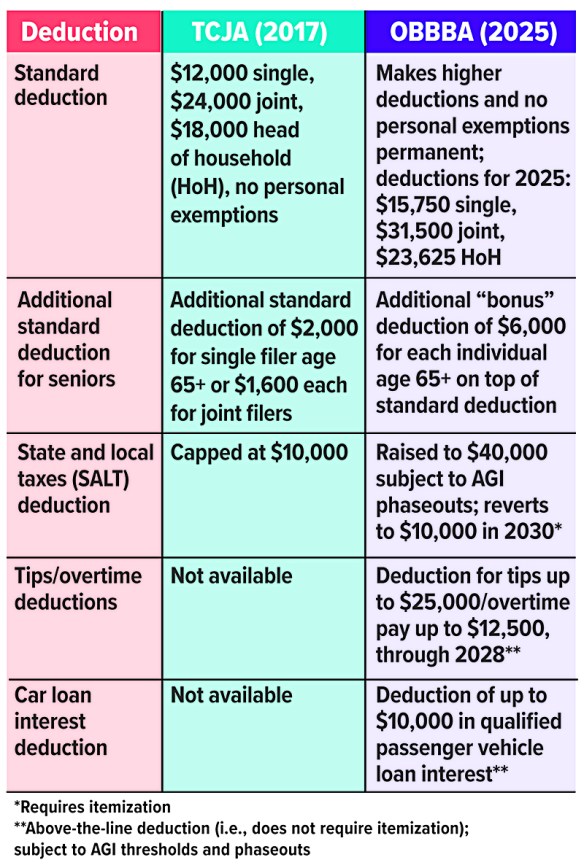
New Deductions

This chart compares some major deductions from the 2017 Tax Cuts and Jobs Act (TCJA) with updates in the One Big Beautiful Bill Act (OBBBA), signed into law on July 4, 2025, and effective for the 2025 tax year.

Questions about this topic? Contact First Financial’s Investment & Retirement Center by calling 732.312.1534. You can also email mary.laferriere@lpl.com or maureen.mcgreevy@lpl.com

Securities and advisory services are offered through LPL Financial (LPL), a registered investment advisor and broker/dealer (member FINRA/SIPC). Insurance products are offered through LPL or its licensed affiliates. First Financial Federal Credit Union (FFFCU) and First Financial Investment & Retirement Center are not registered as a broker/dealer or investment advisor. Registered representatives of LPL offer products and services using First Financial Investment & Retirement Center, and may also be employees of FFFCU. These products and services are being offered through LPL or its affiliates, which are separate entities from and not affiliates of FFFCU or First Financial Investment & Retirement Center.

Securities and insurance offered through LPL or its affiliates are:

The information provided is not intended to be a substitute for specific individualized tax planning or legal advice. We suggest that you consult with a qualified tax or legal professional. LPL Financial Representatives offer access to Trust Services through The Private Trust Company N.A., an affiliate of LPL Financial. Content in this material is for general information only and not intended to provide specific advice or recommendations for any individual. All performance referenced is historical and is no guarantee of future results. All indices are unmanaged and may not be invested into directly. CRPC conferred by College for Financial Planning. This communication is strictly intended for individuals residing in the state(s) of CT, DE, FL, GA, MA, NJ, NY, NC, OR, PA, SC, TN and VA. No offers may be made or accepted from any resident outside the specific states referenced.

1–2) 2025 IRA and HSA contributions can be made up to April 15, 2026.

Prepared by Broadridge Advisor Solutions Copyright 2025.

Fall At-Home Date Nights: Cozy Ideas for the Season

Autumn brings crisp air, changing leaves, and a desire to slow down and savor life’s little comforts. It’s also the perfect time to reconnect with your partner, and you can do that on a budget without ever leaving the house. At First Financial, we believe in building not just financial futures – but meaningful, shared moments. To help you lean into the warmth and creativity this season, here are 10 fall-friendly at-home date ideas that you and your partner will love.

1. Create a Hot Chocolate & Dessert Bar

Transform your kitchen or dining room table into a cozy treat station. Offer various hot chocolate flavors (dark, milk, white, caramel, etc.), whipped cream, flavored syrups, cinnamon sticks, and marshmallows. Pair it with mini desserts like chocolate truffles, cookies, or slices of pumpkin pie. Put on soft music, and enjoy a sweet (literally) conversation.

2. Fall Baking Night

Gather seasonal recipes – think pumpkin bread, apple pie, or pecan cookies, and bake side by side. Work as a team: one mixes the dough, the other decorates or handles clean-up. When it’s ready, enjoy your creation over candlelight with a scoop of vanilla ice cream.

3. Indoor Picnic with a Twist

Lay out a cozy blanket in your living room. Prepare your favorite savory snacks (charcuterie board, grilled cheese, autumn soups) and add candles or string lights to set the mood. Bring in a playlist that reminds you of your earlier days together.

4. Craft Night

Get creative together. Some ideas might include:

  • Making fall wreaths or garland
  • Painting pumpkins
  • Designing homemade candles with scents like cinnamon, apple, or pine
  • Assembling a scrapbook or memory journal

5. Movie Marathon Under a Blanket Fort

Build a cozy fort with blankets and pillows in your living room. Snuggle inside with popcorn and your favorite films or a series you’ve been meaning to watch together.

6. Wine or Cider Tasting

Select a few small bottles of wine or apple cider. Do a mini-tasting indoors, pairing each flavor with small bites like various cheeses, nuts, chocolate, or seasonal fruit. Discuss what you like (and don’t), comparing notes. Bonus points if you try local or regional refreshments.

7. Game Night or Trivia Duel

Dust off your board games or grab some puzzles. Compete in Scrabble, card games, or trivia challenges. Add a fall twist by including themed questions such as, which state produces the most apples? You can even create your own trivia quiz about you as a couple.

8. Read Aloud & Reflect

Pick a short story, poem, or favorite passage from a book and take turns reading aloud. After each reading, pause and reflect on what resonated. Keep things cozy with blankets, a soothing drink, and soft lamps.

9. Outdoor-Indoor Hybrid: Fire Pit & Stargazing

If you have a backyard or patio, light a small fire pit. Wrap yourselves in blankets, sip hot cider or cocoa, bring out blankets and pillows, and gaze at the night sky. You can transition inside later (maybe to that fort you built!) if the temperature drops.

10. Try a Virtual Cooking or Art Class

Sign up for a short online class – such as making pasta from scratch, painting a landscape, or learning to mix cocktails. You’ll follow along side by side, adapting to your pace. At the end, enjoy the fruit of your joint effort.

Final Tips for a Memorable Fall Date Night

  • Set the atmosphere: Dim lights, candles, soft music.
  • Unplug intentionally: Turn off or silence devices.
  • Plan ahead: Pick the menu or craft materials in advance.
  • Be flexible: Let the night evolve organically.
  • Focus on connection, not perfection!

Fall is more than a season – it’s a mood, and a time to slow down and savor. Use these at-home date ideas as a canvas, then tailor them to your own taste as a couple.

Want more inspiration for living well and smart saving? Read more seasonal financial tips and ideas for staying within your budget on our First Scoop Blog!

Calls About a Loan You Never Applied For? What to Know

Have you recently received a call (or many) claiming you have a pending loan application you never submitted? You’re not alone. Many consumers have reported getting these types of calls and while they might sound legitimate, they’re often a sign of a scam or an unethical sales tactic.

What’s Really Going On

If you’re getting calls about loans you never applied for, it’s usually one of two things:

  1. A scammer attempting to steal your personal information. These callers may say they need to “verify your identity” or “finish your loan application,” and ask for sensitive information like your Social Security Number, bank account details, or date of birth. Once shared, that information can be used to commit identity theft or fraud in your name.
  2. A high-pressure sales pitch from a questionable lender. Some companies use aggressive marketing tactics to contact consumers who never inquired about a loan, hoping to push them into accepting an offer on the spot. They may use phrases like “you’ve been preapproved” or “your loan is ready for funding,” to create a false sense of urgency.

Red Flags to Watch Out For

Be cautious if the caller:

  • Asks for personal information over the phone, especially if it’s out of the blue and you haven’t applied for any loans.
  • Pressures you to act immediately or threatens penalties for “not completing” your loan application.
  • Claims to represent a well-known lender, but can’t provide clear verification.
  • Uses generic or suspicious contact information (such as a Gmail address or a masked phone number).

What to Do if You Get One of These Calls

  • Hang up and don’t share personal information. Never confirm your identity or provide sensitive details, unless you initiated the call to a lender you are working with on a known loan application.
  • Verify directly with your financial institution. If you’re unsure, call your bank or credit union using a verified number from their website.
  • Report the scam. You can file a complaint with the Federal Trade Commission (FTC) at reportfraud.ftc.gov or your state’s consumer protection office.
  • Monitor your credit reports. Check your reports regularly for new accounts or inquiries you don’t recognize. You can do this for free at annualcreditreport.com.

Protect Yourself with a Trusted Lender

When you need a loan, always work with a reputable financial institution that prioritizes your safety and privacy. At First Financial, we’ll never contact you out of the blue asking for personal information or pressure you about a loan you didn’t apply for. Our team takes fraud prevention seriously and is here to help you navigate your financial needs with confidence.

Stay informed. Stay secure. And remember, when it comes to unexpected loan calls – it’s always better to hang up and dial your trusted lender directly, than to hand over your personal or financial information to a fraudster.

If you’re ever unsure about a loan offer or you’d like to explore legitimate borrowing options, visit us at firstffcu.com or contact our team directly. Keep Thinking First!