First Financial Foundation Awards Classroom Grant to Cedar Drive Middle School

Press Release

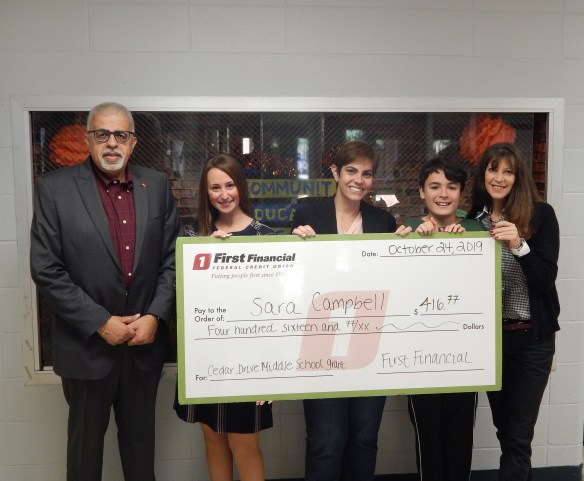
(Pictured above L to R: First Financial’s President/CEO and VP of Marketing and Business Development, Grant recipient Mrs. Sara Campbell, Middle school student Harry Strack, and Mrs. Lori Press).

FREEHOLD, N.J. – Colts Neck’s Cedar Drive Middle School handicap teacher, Sara Campbell, was recently surprised by members of the First Financial Foundation with a $416.77 Erma Dorrer classroom grant for the 2019-2020 school year. Mrs. Campbell has been an elementary school teacher for 14 years, and recently began teaching students with developmental and intellectual disabilities at the middle school level.

Campbell submitted a grant application to purchase equipment for the school’s Colts Cafe. The grant money will be used to continue to change the culture of the school – one snack at a time, through service and vocational skills. Using an old technology cart, a small group of Mrs. Campbell and Mrs. Lori Press’ students started selling snacks and coffee to teachers at the school. This went over so well with the teachers, the idea was suggested to also begin selling snacks to students at the school. The classroom grant awarded will go toward purchasing commercial quality popcorn machines, popcorn, scoops, popcorn seasoning, and popcorn distribution bags.

“When we began to sell coffee and treats to the teachers, our students gained self-confidence and found a place in a community where they had been living on the outskirts,” said Campbell. “They became of service, they found a purpose. And a community found something they didn’t know they were missing.”

(Pictured above L to R: Cedar Drive Middle School Principal Mr. Colin Rigby, Mrs. Sara Campbell, student Harry Strack, and Mrs. Lori Press).

Since First Financial began with a group of Asbury Park schoolteachers back in 1936, the credit union has not forgotten its educational roots. That is why its Foundation offered current Monmouth and Ocean County educators seven (7) classroom grants to use at their schools for the 2019-2020 school year.

“Education has and always will be a pivotal piece of our organization, and we’re delighted to be able to help our local educators enhance their classroom experience,” said First Financial President & CEO, Issa Stephan.

Stephan also noted that the Foundation committee had a tough job of choosing just seven winning teachers out of the numerous applications received this year. “We received double the amount of classroom grant entries this year, which included heartwarming essays and videos from educators hoping to use the grant money to implement or maintain a variety of creative programs within their schools,” said Stephan. “We wish we were able to reward each and every one of our participants, and after extremely careful consideration we selected the seven initiatives in which we felt the grant money would have the largest impact.”

Last Minute Halloween Costumes on a Budget

Halloween is almost here and that means your time to find a costume is limited. If you are like many Americans, a Halloween costume is something that seems to slip to the bottom of the list every year. Whether you are putting together a last-minute fix for your child or a low-key costume for the neighborhood party, we have a few options for you.

Stick with the classics.

Everyone knows Charlie Brown. While his dreary disposition may not seem like the ideal inspiration for a fun Halloween costume, it is important to remember that Charlie always keeps it simple. Stock up on the following materials and create your own Peanuts ghost costume. You’ll need:

  • 1 white bed sheet
  • 5 sheets of black cardboard paper
  • 1 pair of scissors
  • 1 container of glue

Punny is priceless.

Everyone knows someone who doesn’t like to dress up. If you are that person, you’re in luck, this one’s for you. This costume commandeers the style of our Canadian friends and relies heavily on denim (also known as: the Canadian tuxedo). Grab your favorite pair of jeans, a denim jacket or shirt, and one “HELLO MY NAME IS” name tag. Fill out the name tag with the name “Jean” and you’re good to go. As a bonus, this costume will definitely keep you warm even on a cool October night. Costume supplies:

  • 1 pair of jeans
  • 1 denim top
  • 1 “HELLO MY NAME IS” name tag
  • 1 marker
  • Denim shoes or hat (optional)

Kick it old school.

Style is always changing and with decades of life experience comes decades of outdated apparel lining the back of your closet. Dig into your closet and revitalize one of your favorite old-school looks. From the bell-bottoms and big collars of the 70’s to the big hair and bright colors of 80’s – your Halloween costume is probably hiding in your closet, you just have to find it. This one’s easy – you’ll need:

  • Willingness to relive past fashion mistakes (and have fun with it!)

At the end of the day, Halloween is about having fun. Keep the stress and the cost low this year and handle the whole process in-house with these easy last minute costume ideas. Happy Halloween!

3 Steps to Reduce Your Impulse Spending

It can be tough to resist spending money. When you see something you want, especially when it’s at a price you like – it can be difficult to keep from making the purchase. With the way the internet and our smartphone apps have made it so easy to shop, the solution isn’t as simple as just avoiding the stores. If you’ve got an itch for shopping, here are three steps you can take to help you get back in control of your finances.

Take your time: During an impulse buy, for the most part – the whole process from finding the item to paying for it only takes a few minutes. Next time you’re about to hit the “buy now” button, slow down. Put the item in your online shopping cart, but wait before completing the transaction. Try not to buy anything the day you add it to your online cart. Let it sit and think – do you really need this item?

Think it over: If you’re still thinking about that item after sleeping on it, go back into your online shopping cart. In your cart you’ll be able to see the total price (including taxes and shipping), and decide for yourself if the item is really worth that total cost. At this point, look around some more online and try to find a better deal, but still – don’t buy the item (yet). After you’ve done all your research, put the item on your wish list or save it for later.

Be ready: You’ve thought about your purchase for days now, and you know you’re going to buy the item. You’ve done the research and you’ve found the lowest price. Do you have the money to make the purchase in your checking account? If the answer is yes, then go ahead and complete the transaction. If you don’t have the money now, save and start the process over when you’ve saved up enough to buy it without going into debt.

These same steps work for in store impulse purchases too. If you see something you’d like to buy when physically in the store – think about it for a day. The next day do some comparison shopping to make sure you are getting the best price. Still want the item on the 3rd day and you have shopped around and have the money to buy it? Head back to the store and make your purchase.

It pays (literally), to be a savvy shopper and reduce your impulse purchases!

Article Source: John Pettit for CUInsight.com

3 Tips to Keep Debt Away

Sometimes we build up debt due to emergencies or situations that are beyond our control. Sometimes we just buy too many things we don’t really need. Here are three things to think about when it comes to your finances and how you can avoid debt as much as possible.

Set financial goals: Goal-setting is very important when it comes to your money. Your budget should be an easily attainable financial goal for you. If you’re having trouble staying within a budget, it’s probably a good idea to take a closer look at it. When it comes to saving money, have a defined purpose. Every time you get paid, set up your direct deposit to put money into retirement and an emergency fund automatically. This way you won’t physically be transferring the money and convincing yourself that you can do without putting anything into savings this month. If there is a large purchase you want to make or a vacation you want to go on, open a savings account for that wish list.

Have more self-control: It’s easy to buy something impulsively (especially when it’s inexpensive), but those small purchases can really add up if you’re making them all the time. You need to start saying no to yourself and be really disciplined if you want to be free of debt. Having new things is great and exciting, but are those items worth going into debt over?

Ignore pay raises: If you budget your paycheck as if you’re making less than you do, it’ll be easier to save for the things you want in the future. Plus, you won’t have to put yourself in debt to get them. It may not always be easy to cut back, especially if you have a big family, but every little bit helps. And when pay raises come, redirect those additional funds to your savings account and forget all about them!

Article Source: John Pettit for CUInsight.com

How to Save Money Even on a Tight Budget

Saving money is important, but sometimes it can be hard to find extra money to save – right? While saving money can often be a challenge, it’s not impossible to do – even on a strict budget. Here are three ways you may be able to save when your spare funds are on the lower side.

Find deals online: Sites like Groupon or Living Social have a lot of deals in terms of entertainment and dining out. Did you know you can use them for much more? Both often have deals on electronics, automotive repair, health and beauty, home services and more! The best way to find these deals is to register with your zip code and browse around to find how you can save locally. If these are products and services that you’re already going to pay for or that you’re in need of, saving money in the process is an added bonus!

Trim it up: When you go on a diet, you may notice a little bit of weight loss in several different areas of your body. You should treat your budget the exact same way. Don’t try to cut back on (or completely cut out) one budget item, but trim a few dollars from different places. Some bills you aren’t going to be able to budge on, but you will most likely find a few areas you can cut back here and there. Take advantage of these savings and you’ll start to see it add up. Plus, you won’t feel as if you’re cutting anything out of your budget completely.

Spend more time at home: The more you’re out and about, the more you’re going to eat meals out and spend money on items you don’t really need. Instead of meeting your friends out for dinner and a movie, host a potluck dinner (ask everyone to bring something) – and watch your favorite movie or rent one from your local Redbox. You’ll save money, plus you can pause the movie when you need to and not spend a fortune on movie theater snacks. That’s a win-win for everyone!

Need help budgeting? Check out our online budgeting fillable worksheet!

Article Source: John Pettit for CUInsight.com


How to Create an Easy to Follow Budget

Are you the type of person that when you see something you like, you just buy it? It really is important to plan for the future and really take hold of your finances. If you or someone you know doesn’t budget well, here are a few easy ways to get started.

Housing: This category will most likely be the largest portion of your budget. If you’re a homeowner, along with the mortgage, insurance, and property taxes – make sure you include necessary utilities (gas, sewer, electric, etc.), and some extra cash for any emergency repairs. If you’re renting, you’ll still have to budget for your monthly rent and any utilities.

Transportation: When it comes to transportation, there’s a lot more than just your monthly car payment. Gas, insurance, and preventative maintenance such as oil changes – should also be included within your budget. This is another area where it’s a good idea to save some extra cash for any repairs you may not see coming. Planning ahead will help keep your car on the road, which will also keep money in your pocket.

Life: This budget category will cover a lot (think food, health insurance, medical, clothing, entertainment, wireless, tuition, childcare, etc.). All of these items will add up to a sizable portion of your budget. You may need to separate some into their own category and monitor them.

Debt and Savings: This final category is one of the most important. Saving money for your future (401k, Roth IRA) is something you want to make sure you’re doing every month. The earlier you start, the better. You’ll be surprised at how a little each month can add up over time when you make use of compound interest. Also, make sure you’re steadily paying down any debt you have – so you can enjoy your financial freedom.

Need help setting up a budget? Check out our budgeting guide.

Article Source: John Pettit for CUInsight.com