
Finish the Year Strong by Considering These Tax Moves

As 2025 comes to a close, now may be the ideal time to review your tax strategy and find potential opportunities. The steps you take before the end of the year might help you reduce your tax bill. Here are some ideas to consider.

Save now, have more later: If you’re participating in an employer-sponsored 401(k) or 403(b) plan, think about contributing the full pre-tax amount allowed to your retirement accounts by the end of the year. For 2025, the annual limit is $23,500 ($31,000 if you’re age 50 to 59 or 64 and older; $34,750 if you turn age 60, 61, 62, or 63 during the year). If you have a traditional or Roth IRA, you can contribute up to $7,000 for 2025, $8,000 if you’re age 50 or older.1 Traditional IRA contributions may be deductible, but Roth contributions are not.

Time it right, defer or accelerate income: If you expect a significant change in your income from one year to the next — for example, due to a bonus or investment gains — consider deferring or accelerating income. If you expect to be in a lower tax bracket next year, you may benefit from deferring some income into 2026 when it may be taxed at a lower rate. But, if you expect to be in a higher tax bracket next year, accelerating income in 2025 may help reduce your tax liability by taking advantage of your current rate. Timing matters when you’re close to a threshold that impacts tax rates, credits, or deductions.

Hold on for better rates: Holding your investments longer may help reduce your tax bill. If you have stocks or other assets that have appreciated in value, keeping the asset for more than a year means you are typically subject to long-term rates of 0%, 15%, or 20% on any capital gains from a sale (based on your income tax bracket). If you sell the asset earlier than this, your gains are generally taxed at ordinary income tax rates, which may be higher.

Harvest your losses: If you experience capital losses on securities and no longer want to hold the securities in your portfolio, consider selling these underperformers to offset gains from other investments. Losses above the amount of your gains can offset up to $3,000 of ordinary income ($1,500 if your filing status is married filing separately). Unused losses can be carried forward to future years. Watch out for the wash-sale rule, which precludes taking a capital loss deduction if you repurchase the same investment within 30 days before or after selling it.

Save today for your future health costs: Whether you have a health savings account (HSA) through your employer or one you’ve opened individually, contributing more now can help reduce your tax bill. You can boost your HSA savings by increasing payroll deductions or by making direct contributions to your account. For 2025, the contribution limits are $4,300 for individual coverage and $8,550 for family coverage (contributions made by you and your employer count toward this limit). Contributions made through payroll deductions help reduce your taxable income, and contributions made outside of payroll deductions are tax deductible.2

Give more, pay less: If you itemize deductions on your federal income tax return, you can generally deduct charitable contributions, but the deduction is limited to 50% (60% for cash contributions to public charities), 30%, or 20% of your adjusted gross income, depending on the type of property you give and the type of organization to which you contribute. Excess amounts can be carried over for up to five years.

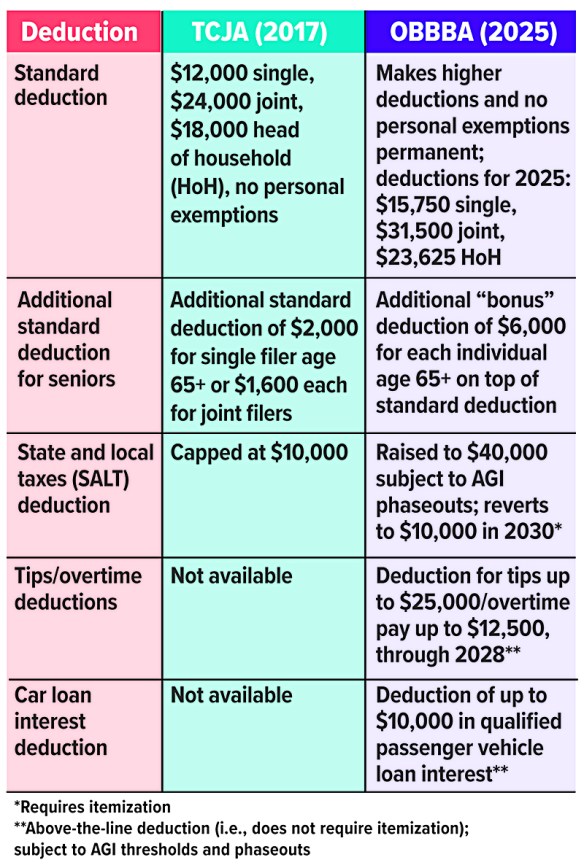
New Deductions

This chart compares some major deductions from the 2017 Tax Cuts and Jobs Act (TCJA) with updates in the One Big Beautiful Bill Act (OBBBA), signed into law on July 4, 2025, and effective for the 2025 tax year.
Questions about this topic? Contact First Financial’s Investment & Retirement Center by calling 732.312.1534. You can also email mary.laferriere@lpl.com or maureen.mcgreevy@lpl.com

Securities and advisory services are offered through LPL Financial (LPL), a registered investment advisor and broker/dealer (member FINRA/SIPC). Insurance products are offered through LPL or its licensed affiliates. First Financial Federal Credit Union (FFFCU) and First Financial Investment & Retirement Center are not registered as a broker/dealer or investment advisor. Registered representatives of LPL offer products and services using First Financial Investment & Retirement Center, and may also be employees of FFFCU. These products and services are being offered through LPL or its affiliates, which are separate entities from and not affiliates of FFFCU or First Financial Investment & Retirement Center.

Securities and insurance offered through LPL or its affiliates are:

The information provided is not intended to be a substitute for specific individualized tax planning or legal advice. We suggest that you consult with a qualified tax or legal professional. LPL Financial Representatives offer access to Trust Services through The Private Trust Company N.A., an affiliate of LPL Financial. Content in this material is for general information only and not intended to provide specific advice or recommendations for any individual. All performance referenced is historical and is no guarantee of future results. All indices are unmanaged and may not be invested into directly. CRPC conferred by College for Financial Planning. This communication is strictly intended for individuals residing in the state(s) of CT, DE, FL, GA, MA, NJ, NY, NC, OR, PA, SC, TN and VA. No offers may be made or accepted from any resident outside the specific states referenced.

1–2) 2025 IRA and HSA contributions can be made up to April 15, 2026.

Prepared by Broadridge Advisor Solutions Copyright 2025.

Fall At-Home Date Nights: Cozy Ideas for the Season

Autumn brings crisp air, changing leaves, and a desire to slow down and savor life’s little comforts. It’s also the perfect time to reconnect with your partner, and you can do that on a budget without ever leaving the house. At First Financial, we believe in building not just financial futures – but meaningful, shared moments. To help you lean into the warmth and creativity this season, here are 10 fall-friendly at-home date ideas that you and your partner will love.

1. Create a Hot Chocolate & Dessert Bar

Transform your kitchen or dining room table into a cozy treat station. Offer various hot chocolate flavors (dark, milk, white, caramel, etc.), whipped cream, flavored syrups, cinnamon sticks, and marshmallows. Pair it with mini desserts like chocolate truffles, cookies, or slices of pumpkin pie. Put on soft music, and enjoy a sweet (literally) conversation.

2. Fall Baking Night

Gather seasonal recipes – think pumpkin bread, apple pie, or pecan cookies, and bake side by side. Work as a team: one mixes the dough, the other decorates or handles clean-up. When it’s ready, enjoy your creation over candlelight with a scoop of vanilla ice cream.

3. Indoor Picnic with a Twist

Lay out a cozy blanket in your living room. Prepare your favorite savory snacks (charcuterie board, grilled cheese, autumn soups) and add candles or string lights to set the mood. Bring in a playlist that reminds you of your earlier days together.

4. Craft Night

Get creative together. Some ideas might include:

  • Making fall wreaths or garland
  • Painting pumpkins
  • Designing homemade candles with scents like cinnamon, apple, or pine
  • Assembling a scrapbook or memory journal

5. Movie Marathon Under a Blanket Fort

Build a cozy fort with blankets and pillows in your living room. Snuggle inside with popcorn and your favorite films or a series you’ve been meaning to watch together.

6. Wine or Cider Tasting

Select a few small bottles of wine or apple cider. Do a mini-tasting indoors, pairing each flavor with small bites like various cheeses, nuts, chocolate, or seasonal fruit. Discuss what you like (and don’t), comparing notes. Bonus points if you try local or regional refreshments.

7. Game Night or Trivia Duel

Dust off your board games or grab some puzzles. Compete in Scrabble, card games, or trivia challenges. Add a fall twist by including themed questions such as, which state produces the most apples? You can even create your own trivia quiz about you as a couple.

8. Read Aloud & Reflect

Pick a short story, poem, or favorite passage from a book and take turns reading aloud. After each reading, pause and reflect on what resonated. Keep things cozy with blankets, a soothing drink, and soft lamps.

9. Outdoor-Indoor Hybrid: Fire Pit & Stargazing

If you have a backyard or patio, light a small fire pit. Wrap yourselves in blankets, sip hot cider or cocoa, bring out blankets and pillows, and gaze at the night sky. You can transition inside later (maybe to that fort you built!) if the temperature drops.

10. Try a Virtual Cooking or Art Class

Sign up for a short online class – such as making pasta from scratch, painting a landscape, or learning to mix cocktails. You’ll follow along side by side, adapting to your pace. At the end, enjoy the fruit of your joint effort.

Final Tips for a Memorable Fall Date Night

  • Set the atmosphere: Dim lights, candles, soft music.
  • Unplug intentionally: Turn off or silence devices.
  • Plan ahead: Pick the menu or craft materials in advance.
  • Be flexible: Let the night evolve organically.
  • Focus on connection, not perfection!

Fall is more than a season – it’s a mood, and a time to slow down and savor. Use these at-home date ideas as a canvas, then tailor them to your own taste as a couple.

Want more inspiration for living well and smart saving? Read more seasonal financial tips and ideas for staying within your budget on our First Scoop Blog!

Calls About a Loan You Never Applied For? What to Know

Have you recently received a call (or many) claiming you have a pending loan application you never submitted? You’re not alone. Many consumers have reported getting these types of calls and while they might sound legitimate, they’re often a sign of a scam or an unethical sales tactic.

What’s Really Going On

If you’re getting calls about loans you never applied for, it’s usually one of two things:

  1. A scammer attempting to steal your personal information. These callers may say they need to “verify your identity” or “finish your loan application,” and ask for sensitive information like your Social Security Number, bank account details, or date of birth. Once shared, that information can be used to commit identity theft or fraud in your name.
  2. A high-pressure sales pitch from a questionable lender. Some companies use aggressive marketing tactics to contact consumers who never inquired about a loan, hoping to push them into accepting an offer on the spot. They may use phrases like “you’ve been preapproved” or “your loan is ready for funding,” to create a false sense of urgency.

Red Flags to Watch Out For

Be cautious if the caller:

  • Asks for personal information over the phone, especially if it’s out of the blue and you haven’t applied for any loans.
  • Pressures you to act immediately or threatens penalties for “not completing” your loan application.
  • Claims to represent a well-known lender, but can’t provide clear verification.
  • Uses generic or suspicious contact information (such as a Gmail address or a masked phone number).

What to Do if You Get One of These Calls

  • Hang up and don’t share personal information. Never confirm your identity or provide sensitive details, unless you initiated the call to a lender you are working with on a known loan application.
  • Verify directly with your financial institution. If you’re unsure, call your bank or credit union using a verified number from their website.
  • Report the scam. You can file a complaint with the Federal Trade Commission (FTC) at reportfraud.ftc.gov or your state’s consumer protection office.
  • Monitor your credit reports. Check your reports regularly for new accounts or inquiries you don’t recognize. You can do this for free at annualcreditreport.com.

Protect Yourself with a Trusted Lender

When you need a loan, always work with a reputable financial institution that prioritizes your safety and privacy. At First Financial, we’ll never contact you out of the blue asking for personal information or pressure you about a loan you didn’t apply for. Our team takes fraud prevention seriously and is here to help you navigate your financial needs with confidence.

Stay informed. Stay secure. And remember, when it comes to unexpected loan calls – it’s always better to hang up and dial your trusted lender directly, than to hand over your personal or financial information to a fraudster.

If you’re ever unsure about a loan offer or you’d like to explore legitimate borrowing options, visit us at firstffcu.com or contact our team directly. Keep Thinking First!

Retire with a Spending Plan

Do you have a spending plan in place for when you retire? Many retirees worry about outliving their money. It’s important to have a strategy for withdrawing and using your retirement assets.

First, you’ll need to determine a practical, yearly withdrawal amount. Some households adopt the 4% rule, which entails removing 4% from their savings annually. That rule, however, has its critics, many of whom feel it can backfire in a volatile market. Some retirees try to withdraw a set dollar amount annually. Others withdraw a fixed percentage of their portfolio or aim to live off its interest rather than its principal. There is also the “bucket” approach, in which a retiree withdraws cash to live on from an account that would be “refilled” with investment earnings from other accounts.

Second, keep in mind the order in which you withdraw from your accounts. It may be preferable to withdraw income from your taxable investment accounts first. That way, you can give your tax-deferred accounts a chance to grow and compound further. Generally, withdrawals from tax-deferred retirement accounts are required at age 72. Because the taxable income resulting from these mandatory withdrawals may put you in a higher tax bracket, one option is to start allowing withdrawals from these accounts earlier (after age 59 1/2) – the smaller the account balance, the smaller the mandatory withdrawal becomes.

As your retirement progresses, you’ll want to review your strategy. Life events, investment returns, inflation and other factors may call for adjustments. The key is to have a plan in place that you can then modify as needed.

Contact us today to learn more about developing a savings strategy that’s right for you.

Questions about this topic? Contact First Financial’s Investment & Retirement Center by calling 732.312.1534.  You can also email mary.laferriere@lpl.com or maureen.mcgreevy@lpl.com

Securities and advisory services are offered through LPL Financial (LPL), a registered investment advisor and broker/dealer (member FINRA/SIPC). Insurance products are offered through LPL or its licensed affiliates. First Financial Federal Credit Union (FFFCU) and First Financial Investment & Retirement Center are not registered as a broker/dealer or investment advisor. Registered representatives of LPL offer products and services using First Financial Investment & Retirement Center, and may also be employees of FFFCU. These products and services are being offered through LPL or its affiliates, which are separate entities from and not affiliates of FFFCU or First Financial Investment & Retirement Center.

Securities and insurance offered through LPL or its affiliates are:

This material is for general information only and is not intended to provide specific advice or recommendations for any individual. There is no assurance that the views or strategies discussed are suitable for all investors or will yield positive outcomes. Investing involves risks including possible loss of principal.

This material was prepared by LPL Financial, LLC

Tracking #485871

The Differences Between a Will, Living Will, Trust, and Power of Attorney

In addition to a power of attorney, there are several other documents that are critical to consider when getting your estate in order. Estate planning is the process of designating who will receive your assets and handle your responsibilities after your death or incapacitation. The main benefit of estate planning is that it ensures your wishes are carried out when you are no longer able to do so, making you feel more organized and confident that your loved ones won’t be unnecessarily burdened in the future. We will discuss some of the potential benefits of specific documents that can be included in an estate plan, such as a will, living will, and trust – as well as revisit some of the benefits of a power of attorney.

Wills

A Will is a legal document that outlines how you’d like your assets distributed after your death. It allows you to name an executor who will manage your estate, pay any debt and distribute your assets. You can also designate guardians for minor children. For business owners, a will can help successfully and efficiently transition assets.

A main benefit of a will is that although it does not avoid the probate process, it can make things much easier. Legally speaking, anything that speeds up the process of physical asset distribution can minimize fees and make things easier for everyone involved. It can also eliminate any potential family disputes over who gets which assets. However, it’s important to remember that a will is only a roadmap. It’s best to make sure that all of your financial assets and valuable possessions (like a home or a car) have beneficiaries named in other documents besides the will.

Living Wills

A living will, also known as an advanced healthcare directive, states your wishes regarding life-prolonging medical treatments. It comes into play only when an individual faces a life-threatening condition and is unable to communicate their desires for treatment.

One of the main benefits of a living will is that it speaks for you when you become incapacitated or unable to communicate – it states your desires for medical treatment if you are unable to make those decisions yourself. Without a living will, decisions regarding medical care become the responsibility of a spouse, family members, or other third parties. These individuals may be unaware of your desires if they are unwritten.1

Trusts

A trust is a legal entity that can “own” assets. The document looks much like a will, and includes instructions for who is to handle final affairs and who is to receive the deceased’s assets. There are many types of trusts.

Today, many people use a revocable living trust instead of a will in their estate plan because of this benefit – it avoids court interference at death and at incapacity. For a living trust to work properly, you must transfer your assets into it. Titles must be changed from your “individual” name to the name of your trust. Because your name is no longer on any titles, there is no reason for the court to get involved if you become incapacitated or when you pass away. This makes it easy for a trustee or successor trustee, to step in and manage your financial affairs. Another benefit of a trust is that it is private, whereas a will is not because it goes into public records.

Power of Attorney

Typically, a power of attorney (POA) is a document that authorizes someone to handle financial and some legal decisions when you become incapacitated. Anyone you trust, such as a family member or friend, can serve in this role for you. You can even designate more than one person, assigning different responsibilities to each.

It’s important to have a power of attorney, because it will allow the person you assign to act on your behalf when you are unable to do so yourself. Without a power of attorney, a court may be left to decide what happens to your assets if you are found to be mentally incompetent, and the court’s decision may not be what you intended. A POA can give your agent the power to transact real estate, perform financial transactions, and make other legal decisions as if he or she were you. It’s important to reiterate that you assign this person – meaning you can select a person whom you believe will be able to carry out your wishes and ensure your affairs are kept in order.

Estate plans are not “one-size-fits-all.” It is up to you to determine which components are best for you and your loved ones. Although it might feel overwhelming, starting with one or many of these items will give you peace of mind in knowing you have taken the first step to creating your estate plan.

Should you be thinking about your financial future and retirement, as well as estate planning – the First Financial Investment & Retirement Center will be hosting an exclusive no-cost virtual seminar on the Transitions to Retirement featuring a bonus segment on Estate Planning, on Wednesday, October 8th at 6pm.

(697533-1 and 622155)

You can register for this session from the link above or by contacting Maureen McGreevy, LPL Financial Advisor at 732.312.1534 or emailing maureen.mcgreevy@lplfinancial.com

Securities and advisory services are offered through LPL Financial (LPL), a registered investment advisor and broker/dealer (member FINRA/SIPC). Insurance products are offered through LPL or its licensed affiliates. First Financial Federal Credit Union (FFFCU) and First Financial Investment & Retirement Center are not registered as a broker/dealer or investment advisor. Registered representatives of LPL offer products and services using First Financial Investment & Retirement Center, and may also be employees of FFFCU. These products and services are being offered through LPL or its affiliates, which are separate entities from and not affiliates of FFFCU or First Financial Investment & Retirement Center.

Securities and insurance offered through LPL or its affiliates are:

This information is not intended to be a substitute for individualized legal advice or estate planning advice. Please consult your legal or estate planning advisor regarding your specific situation.

Sources:

  1. Investopedia.com, February 17, 2025

LPL tracking #’s referenced: 1-05375681, 676252, 653950, 513868

Unemployment Scams: How to Protect Yourself

Unemployment benefits are meant to help people without a job during tough times. Unfortunately, scammers have been known to sometimes take advantage of the system by filing for these benefits using someone else’s personal information. Even if you never applied for unemployment, you could suddenly receive benefits notices, tax forms, or even payments tied to your identity. That’s a big red flag. Keep reading to learn how to spot an unemployment scam and ways you can protect yourself and your finances.

How to Spot an Unemployment Scam

There are often a few telltale signs something isn’t right. If you applied for unemployment, you might find that your application was denied because someone already filed under your name, or that your benefits were approved – but the money never arrived.

If you didn’t apply, you may receive letters from the state unemployment office, a notice from your employer that someone used your identity, or even a 1099-G tax form showing unemployment income you never received. In some cases, money may even show up in your bank account, followed by a call from someone claiming it was a mistake.

Why This Matters

Unemployment scams often lead to bigger problems. Identity thieves may use your personal details to commit other types of fraud, damage your credit, or create headaches at tax time. If you do ever need unemployment benefits in the future, your claim could also be delayed or denied.

How to Protect Yourself

To avoid an unemployment scam from happening to you:

  • Only share sensitive information like your Social Security Number or bank details through official, trusted channels.
  • Always file for unemployment directly through your state’s unemployment agency website.
  • Monitor your credit reports for suspicious activity and consider freezing your credit if you suspect fraud.
  • Watch for IRS forms that don’t match your situation, such as a 1099-G for benefits you didn’t receive.
  • Report suspicious activity right away to your state unemployment office, your employer, and the FTC.

First Financial is Here for You

At First Financial, we take your security seriously. Our team works around the clock to protect our members’ accounts, monitor unusual activity, and provide resources if you think you’ve been a victim of fraud. If you ever suspect an unemployment scam or identity theft regarding one of your First Financial accounts, reach out to us immediately – we’re always here to help safeguard your finances.

Stay up to date on the latest in scams by subscribing to our First Scoop Blog, and following along with our Important Alerts and Scams articles.