7 Ways to Save More Money This Year

Icon of coupon cutout with money1. Change Cell Phone Providers

Smartphones have become commonplace in today’s society. While that brings a number of benefits, it also brings one major problem – the cell phone bill. According to a recent study at CouponCabin.com, 46 percent of Americans have a cell phone bill of at least $100 per month with another 13 percent over $200. The major culprit behind this is the cell phone contract. Many people believe that if you’re under a contract, you’re obligated to pay that amount. However, a simple call to your provider to review your needs can often result in saving money by reducing the plan. If you’re not in a contract, or are coming up for renewal, consider one of the many reputable non-contract offerings out there such as Straight Talk Wireless, etc. – as you can often get coverage for less than $50 per month.

2. Change Your Grocery Shopping

The average grocery bill for a family of four can be as high as almost $300 a week. The good news is that there are ways to significantly cut that amount. Some of those might be painful changes, but can save you real money. Look at how often you go to the store. Can you extend the time between trips? Can you coupon as well? Another idea is to have a freezer or pantry week once a month, or once per quarter. This forces you to use everything in your kitchen, reduce food waste and save money.

3. Reduce Entertainment Costs

It’s no surprise that cable bills can be expensive. The obvious alternative to save money is to cut the cord. If that’s not an option for you and your family, then analyze the channels you are watching, as you can often reduce your cable package and save yourself some money each month. Even if you have ditched cable altogether, look at what alternatives you’re using. You may find that you only need two plans to get your shows and not three. Cut the third one and put some of that money back in your pocket.

4. Cut Insurance Bills

Insurance, in many cases, is a necessary evil. In the case of auto insurance you obviously need it, but that doesn’t mean you can’t save money on it. Like with cable and your cell phone, analyze your insurance needs. If you drive an older car do you really need full coverage? Are you driving fewer miles? Can you afford to increase your deductible? Those are all justifiable ways to save money on your auto insurance, not to mention comparing other companies.

5. Kill the Interest Rates

Many Americans carry debt, and debt of course – carries interest responsibilities with it. Depending on the type of debt you will likely have options to find lower interest rates. If you’re dealing with credit card debt, you can try and do a balance transfer to a lower rate card. If you’re hacking away at student loan debt you can look into consolidating for a lower rate. Better yet, pay off the debt altogether if you’re able.

First Financial has a great Visa Platinum Cash Plus Card with a really low rate and no annual fee, plus rewards for purchases!* Get started by applying online today.

6. Don’t Always Call in the Pros

If you’re a homeowner, than you know how often it seems that something breaks or needs replacing. The temptation is to call in a professional to fix the issue, but that can cost a pretty penny. Instead of calling in a pro, try doing it yourself (depending upon what the issue is of course). It may feel daunting, but many jobs require only simple tools to take care of them. If you don’t know how to do a certain task, the Internet is a great resource for free tools and YouTube videos that can teach you how to do something. That can result in a huge money savings, not to mention the satisfaction of learning something new.

7. Fall In Love With a Budget

While not necessarily a task that will allow you to save money, starting a budget will indeed allow you to save more money. Don’t let the feeling that budgeting is restrictive hold you back, as it can actually be quite freeing. There are many ways to budget and many free resources available to help get you started (like this First Scoop blog, or by attending one of First Financial’s annual budgeting seminars). Find what works best for you and modify it to your life. This will allow you to see what spending fat can be trimmed which will help you control your money and not the other way around.

It may feel like it’s impossible to save money in most cases. However, with a little work and research – you can often find many areas in which you can save money pretty easily!

*APR varies up to 18% for purchases, when you open your account based on your credit worthiness. The APR is 18% APR for balance transfers and cash advances. APRs will vary with the market based on the Prime Rate. Subject to credit approval. Rates quoted assume excellent borrower credit history. Your actual APR may vary based on your state of residence, approved loan amount, applicable discounts and your credit history. No Annual Fee. Other fees that apply: Cash advance fee of $10 or 3% of the total cash advance amount—whichever is greater (no maximum), Balance transfer fee of $10 or 3% of the balance—whichever is greater (no maximum), Late Payment Fee of $29, $10 Card Replacement Fee, and Returned Payment Fee of $29. A First Financial membership is required to obtain a Visa® Credit Card and is available to anyone who lives, works, worships, or attends school in Monmouth or Ocean Counties.

Article Source: John Schmoll for Money.USNews.com, http://money.usnews.com/money/the-frugal-shopper/2015/01/13/7-ways-to-save-more-money-this-year

How To Save When You’re Young

Businesswoman saving moneyIt’s hard to save money when you’re young. If you’re lucky enough to have a job, you’re probably not overflowing with cash. With a ton of young and talented job seekers, companies also have little pressure to offer generous starting salaries.

Meanwhile, apartment rents have steadily risen for 23 straight quarters, and life’s other inevitable expenses — utilities, food, taxes, etc. And these haven’t gotten any cheaper.

Let’s not forget educational expenses too. Inflation in college tuition has massively outpaced broader consumer price inflation for decades, meaning most college graduates start their careers with large student loan debts hanging over their heads. A recent poll found that college graduates finish their studies with an average debt load of $35,200. And if you are the ambitious type who decided to go to graduate school, you might have multiple hundreds of thousands of dollars in student loan debt.

Still, the savings you manage to sock away while you’re young will have an outsized effect on the lifestyle you’re able to live when in middle age and your golden years.

Pay Yourself First.

Humans are hardwired to expand our spending to absorb any increases in income. In order to mitigate these impulses, you have to “pay yourself first” by allocating your first dollar of income to savings rather than your last. Figure out a dollar amount that you want to save, and set it aside before you budget your regular monthly expenses.

If your employer offers a 401k plan, this is easy enough to do. Your 401k contributions come out of your paycheck before you have a chance to spend them. Not including the value of employer matching, if your employer offers this – is an “out of sight, out of mind” way to save for your retirement one day.

Even contributing $500 per month to savings will get you to $6,000 per year, and many young workers can try to make do with $500 less per month.

Make it Automatic.

Very closely related to paying yourself first is making your savings as automated as possible. For example with a 401k plan, this accomplishes both. Once you set your contribution limits, your company’s payroll department will take care of the rest. It’s automated, and you don’t have to think about it.

But what if your company doesn’t offer a 401k plan? There are plenty of other ways to automate your savings process. Often times, your payroll department will allow you to split your paycheck among two or more accounts. This will allow you to automatically divert whatever sum you can afford away from your primary checking account and into a savings or investment account.

You can also generally instruct your brokerage account or savings account to automatically draw from your checking account on a specified day every month. The key here is automating the process so as to remove your discretion. If you have a real emergency, you can always suspend the automated instructions for the time being. Otherwise, you have made saving part of your monthly routine and made it a lot harder to throw the money away on something frivolous.

Slash Your Budget.

Let’s face it, it can be easier said than done when your monthly bills seem to get bigger every month. Here are a few concrete examples of how to save without crimping your lifestyle too badly.

First off, ditch cable TV. Most of the programming you watch is probably available for free over the airwaves or at a very modest cost with Hulu Plus or Netflix  after a short delay. And the handful of shows not available probably aren’t worth the $100 per month or more you’ll pay in cable bills. If you can’t live without HBO, chances are good that one of your friends or relatives has a subscription that you can borrow from time to time.

Also, try to put off a new car purchase as long as possible. If you take reasonably good care of your car, it will last you 150,000-200,000 miles. Not only will you save money on a car payment, but the older your car the less insurance coverage you will need. And when you finally do need to replace your wheels, buy a late-model used car rather than a new one.

Did you know at First Financial, our auto loan rates are the same whether you buy new or used? Be sure to check them out today, and if you like what you see – you can apply for an auto loan online 24/7.*

Consider cutting your rent and utilities bills in half by having a roommate. Chances are, you did it in college. Why not share an apartment for a few more years? The average apartment rent is more than $1,000 per month, and it is considerably more in the popular urban cities that attract younger people. Cutting that bill in half will make reaching your savings goals a lot easier.

*APR = Annual Percentage Rate. Not all applicants will qualify, subject to credit approval. Additional terms and conditions may apply. Actual rate may vary based on credit worthiness and term. First Financial FCU maintains the right to not extend credit, after you respond, if we determine you do not meet our guidelines for creditworthiness. A First Financial membership is required to obtain an Auto Loan and is available to anyone who lives, works, worships, volunteers or attends school in Monmouth or Ocean Counties.

Article Source: Charles Sizemore for investorplace.com, http://investorplace.com/2014/12/how-to-save-when-youre-young/#.VL65zNLF8uc


The 10 Commandments of Saving Money

saving moneyThere are thousands of savings tips that can help you grow your nest egg. Whether they involve brown-bagging it to work or using coupons at the supermarket, these are generally useful savings habits that can give you a leg up on ending each month in the black.

But there are only a few super-sized savings rules that can truly transform your finances. Rules so big they deserve to be etched in stone. So, here are the “The Ten Commandments” of saving.

1. Thou Shalt Know Where Thy Money Goes

When generals go to war, they need an overview of the battlefield. Maps, exploration and data show them where the enemy is susceptible. In the battle for savings, the first thing you have to know is where your money is going.

Sites like Mint.com allow you to connect all your bank accounts, credit cards and loans to cloud-based software so you to track your finances on one screen, in real time, with just the click of a button. They also analyze your expenses and highlight areas where you might be wasting money. Best of all, it’s free.

2. Thou Shalt Eliminate Debt with Extreme Prejudice

Debt is bad, but it’s the interest on that debt that’s like kryptonite to your savings goals, and the sooner you eliminate it, the sooner you can become a savings Superman.

Moving debt from high-interest instruments, like credit cards, to lower-interest instruments, like a line of credit, is a start. Consolidation loans can be a help as well, but the easiest way to get out of debt fast is to take the interest expense you save and put it directly toward your debt’s principal amount.

First Financial’s Visa Platinum Cash Plus Credit Card has one of the lowest APRs around! It’s a good idea to check the APR on your current credit cards to see if it’s time to switch.  You can apply for a balance transfer by stopping into any branch or by calling 732.312.1500, Option 4.*

3. Thou Shalt Read the Fine Print

Most people would be shocked at the amount of money that they waste on service charges, convenience fees and annual dues hidden in financial contracts. If that low-interest credit card charges you $99 annually no matter if you use it or not, is it really that great of a deal?

Make sure if you transfer a balance to a lower-interest credit card that there is not a transaction fee attached. And if you rarely or never use that credit card with the annual fee, think about applying for a card that better suits your financial well-being.

4. Thou Shalt Pay Attention to Timing

At the risk of sounding like a ’60s folk-rock star, to everything there is a season, and waiting for the right season to purchase big-ticket items can save you a bundle. For example, car dealers will discount their inventory when the new model year arrives to free up room on their lots, so If you are in the market for a new car, that’s the season to buy.

Many big-box retailers and department stores have semi-annual sales where you can pick up appliances, electronics and home goods at a discount. The key is to fight against the urge for instant gratification on your purchases.

5. Thou Shalt Keep an Eye on Interest Rates

Even if you are able to pay off your credit cards and loans, the one debt most people can’t pay off is their home mortgage, which is why you should watch interest rates. When interest rates move down, it can be an opportunity to refinance your home loan and save money on your monthly mortgage payment.

But remember, if you just take the money you save and spend it, you’re not saving at all. Earmark the difference between your new mortgage payment and your old one for your bank account, or if you plan to live in your home for the life of the loan, put the extra toward your principal and own your home sooner.

6. Thou Shalt Find Money in Thy House

Most people would be surprised to learn just how much money they have laying around their house. Those books you’ve already read can be sold on Cash4Books or Amazon.com, and your old phones and mobile devices can be sold to companies like Gazelle.

Cleaning out the clutter in your home doesn’t just feel good but provides you with an opportunity to feed your piggy bank by having a garage or yard sale. And what about those figurines you inherited or your comic book collection? Do you still really want them? If not, try listing them on eBay.

7. Thou Shalt Use Technology to Find Deals

The Internet makes saving money so easy that your grandmother would likely throw her coupon box at your head if she knew. Sites like Groupon and Living Social will send deals on goods and services in to your inbox, and apps like Out of Milk can alert you to store sales just by driving by them.

The Internet also is a great resource for finding free activities for you and your family to do on weekends, holidays and school breaks.

Subscribe to our First Scoop Blog and receive free, fun financial education straight to your inbox – at the beginning of each month we post a budget-friendly activity list for that month in Monmouth and Ocean Counties, NJ!

8. Thou Shalt Not Forget to Prioritize Your Retirement

This is a tough one, because it’s hard to save money now that you don’t expect to use for 30 or 40 years. But like it or not, there is going to come a time when your earning years are over and we will all need a retirement fund to bankroll the golden years. So if you don’t want yours to be bronze years, you have to make retirement saving a priority.

The good news is that you have many years to accumulate those funds and to let them grow, which means that small amounts of savings directed toward it can go a long way. For example, you can take a percentage out of every saved dollar, say 25 percent, and earmark it for your retirement. This is an easy and painless way to create both a short-term and long-term savings fund.

To set up a no-obligation appointment with our Investment & Retirement Center to go over your retirement and investment portfolio or to get started with one, call 732.312.1500 or email mary.laferriere@lpl.com or maureen.mcgreevy@lpl.com.**

9. Thou Shalt Not Try to Keep Up With the Joneses

A huge part of winning the saving game is changing your mindset about how you think of money and what its function is. Too often we get caught up in the game of keeping up with the Joneses and buy things we don’t really want — and certainly don’t need — just to keep up appearances.

What many people don’t take into account is that that boat, RV, ATV, third car or giant flat screen that their neighbor bought probably comes with a loan or a high-interest credit card payment. Before making that next impulsive purchase, ask yourself if you really want it and if it will bring you that same warm fuzzy feeling that a full savings account will.

10. Thou Shalt Act Like Thy Don’t Even Have It

We can’t spend what we don’t have, so the more you act like you don’t have it, the more you will be able to save it. Have retirement and college savings funds automatically deducted from your paycheck before you ever see it. Schedule a “secret” payment from your checking account to your savings account each week.

When you come across found money — like a rebate, an overpayment refund or even $20 in your pants pocket — just act like you never had it and put it right into your savings. With practice, you can get pretty good at this, so much so that if you have an unexpected windfall — say from an investment or an inheritance — you’ll forget it even happened. Only your savings account will know.

*APR varies up to 18% for purchases, when you open your account based on your credit worthiness. The APR is 18% APR for balance transfers and cash advances. APRs will vary with the market based on the Prime Rate. Subject to credit approval. Rates quoted assume excellent borrower credit history. Your actual APR may vary based on your state of residence, approved loan amount, applicable discounts and your credit history. No Annual Fee. Other fees that apply: Cash advance fee of $10 or 3% of the total cash advance amount—whichever is greater (no maximum), Balance transfer fee of $10 or 3% of the balance—whichever is greater (no maximum), Late Payment Fee of $29, $10 Card Replacement Fee, and Returned Payment Fee of $29. A First Financial membership is required to obtain a Visa® Credit Card and is available to anyone who lives, works, worships, or attends school in Monmouth or Ocean Counties.

**Securities and advisory services are offered through LPL Financial (LPL), a registered investment advisor and broker/dealer (member FINRA/SIPC). Insurance products are offered through LPL or its licensed affiliates. First Financial Federal Credit Union (FFFCU) and First Financial Investment & Retirement Center are not registered as a broker/dealer or investment advisor. Registered representatives of LPL offer products and services using First Financial Investment & Retirement Center, and may also be employees of FFFCU. These products and services are being offered through LPL or its affiliates, which are separate entities from and not affiliates of FFFCU or First Financial Investment & Retirement Center.

Securities and insurance offered through LPL or its affiliates are:

8 Foolproof Ways to Grow Your Savings

Money plant over white backgroundA typical emergency fund should contain at least six months’ worth of net income (up to a year is recommended if you have kids or other dependents), and you should only touch it in a true emergency (no, under no circumstances is your dream vacation to Tahiti a true emergency).

Here are five examples of situations that qualify as actual financial emergencies:

  • Emergency 1: You’ve lost your job and need to continue paying rent, bills, and other living expenses.
  • Emergency 2: You have a medical or dental emergency.
  • Emergency 3: Your car breaks down and it is your primary form of transportation.
  • Emergency 4: You have emergency home expenses. For example, your air conditioning unit breaks down in 100-degree weather, your roof is leaking, your basement is flooded (no again, a kitchen in need of redecorating doesn’t count, no matter how much you hate that wallpaper or your “outdated” cabinets).
  • Emergency 5: You have bereavement-related expenses, like travel costs for a family funeral.

Here’s another reason why you should always have money in an emergency fund: If you don’t, and one of these five situations occurs, you’ll most likely be stuck using a credit card to handle it, leading you into (or deeper into) credit card debt. In fact, medical expenses are the leading contributor to credit card debt, with low-to moderate-income households averaging $1,678 in credit card debt due to out-of-pocket medical expenses.

Plus, paying for emergency expenses on your credit card (if you don’t pay off your bill immediately) will end up costing you more over time, when you rack up interest payments as you try to dig yourself out of debt. Having an emergency fund will not only save you more money in the long run, but it will also give you peace of mind in knowing you have the safety net to catch those unexpected curveballs when they arrive.

If getting six months of take-home pay together seems daunting, here are eight useful tips that might better help you boost your emergency savings:

1. Direct Deposit into Your Savings

Think of yourself as a regular monthly bill you have to pay. All you have to do is arrange to have a set amount of money directly deposited from your paycheck into a savings account each month. The savings account is recommended because if you use your checking account, you may be tempted to spend the money you are trying to set aside. It might hurt a bit at first to take home a little less every month, but after awhile you won’t even notice it’s gone. Here’s a moment when the “set it and forget it” strategy works wonders!

2. Never Spend a Bonus Again

It feels great to be rewarded for your hard work. And it feels even better to spend that hard-earned bonus on something you’ll enjoy, like a trip to the Caribbean or a new tablet. At the same time, the pleasure of a vacation or new gadget is short-lived compared to financial security.

So make a pact with yourself to put every bonus you get from here on out to good use. If you direct 90 percent of your bonuses straight into your savings account as a rule, you’ll still have 10 percent to treat yourself with (plus the comfort of knowing that you’re building a well-earned safety net).

3. Cut Unnecessary Costs

This seems like an obvious one — and is easier said than done. Actually, most people spend money on more unnecessary items than they think. So take time to look at where your money is going in detail and begin to cut back. Saving $10 here and $5 there could help you put a lot away in the long run – you’d really be surprised.

4. Open a Seasonal Savings Account

Many financial institutions offer seasonal accounts meant to save for the holidays. These accounts give you reduced access to your accounts, charging a penalty each time you withdraw more than permitted. Since emergencies (hopefully) don’t occur often, a seasonal account could make sure you’re touching it only when needed.

Check out First Financial’s Holiday Savings Club Account – don’t put yourself into debt over holiday spending, save ahead and come out on top (and not in debt)!*

  • Open at any time
  • No minimum balance requirements
  • Dividends are posted annually on balances of $100 or more
  • Accounts automatically renew each year
  • Deposits can be made in person, via mail, payroll deductions, or direct deposit
  • Holiday Club funds are deposited into a First Financial Checking or Base Savings Account

5. Sell Unused Items

Rather than throwing these unused goods away, start selling them, and put that money into your emergency fund. All you need to do is post them to a site like eBay, Craigslist, or Amazon and you can get rid of items from the comfort of your home. You can also take your clothes to a consignment shop to have them sold for you.

6. Stop Spending $5 Bills

Instead of saving your pennies, put aside any $5 bills that come your way. Never spend a $5 bill again, and you’ll be surprised by how quickly this little trick will help you come up with a few hundred dollars to add to an emergency fund.

7. Earn Extra Income

You could pick up odd jobs to help do things for other people, freelance writing/blogging, or babysitting via websites like TaskRabbit.com, DoMyStuff.com, Elance.com, FreelanceSwitch.com, or Sitters.com. Or if you have the time – go out and find an additional part-time job as a cashier, server, or utilize your hidden talents in web design, catering, and so on.

8. Use Cash Back Rewards

If you get a cash-back reward for any spending on your credit card, just make it a rule that those dollars will be dedicated to your emergency fund. It may only add up to $100 extra each year, depending on your spending, but every little bit counts!

*A $5 deposit in a base savings account is required for credit union membership prior to opening any other account. All personal memberships are part of the Rewards First program and a $5 per month non-participation fee is charged to the base savings account for memberships not meeting the minimum requirements of the program. Click here to view full Rewards First program details. Accounts for children age 13 and under are excluded from this program.

new%20ncua%20disclaimer-resized-600

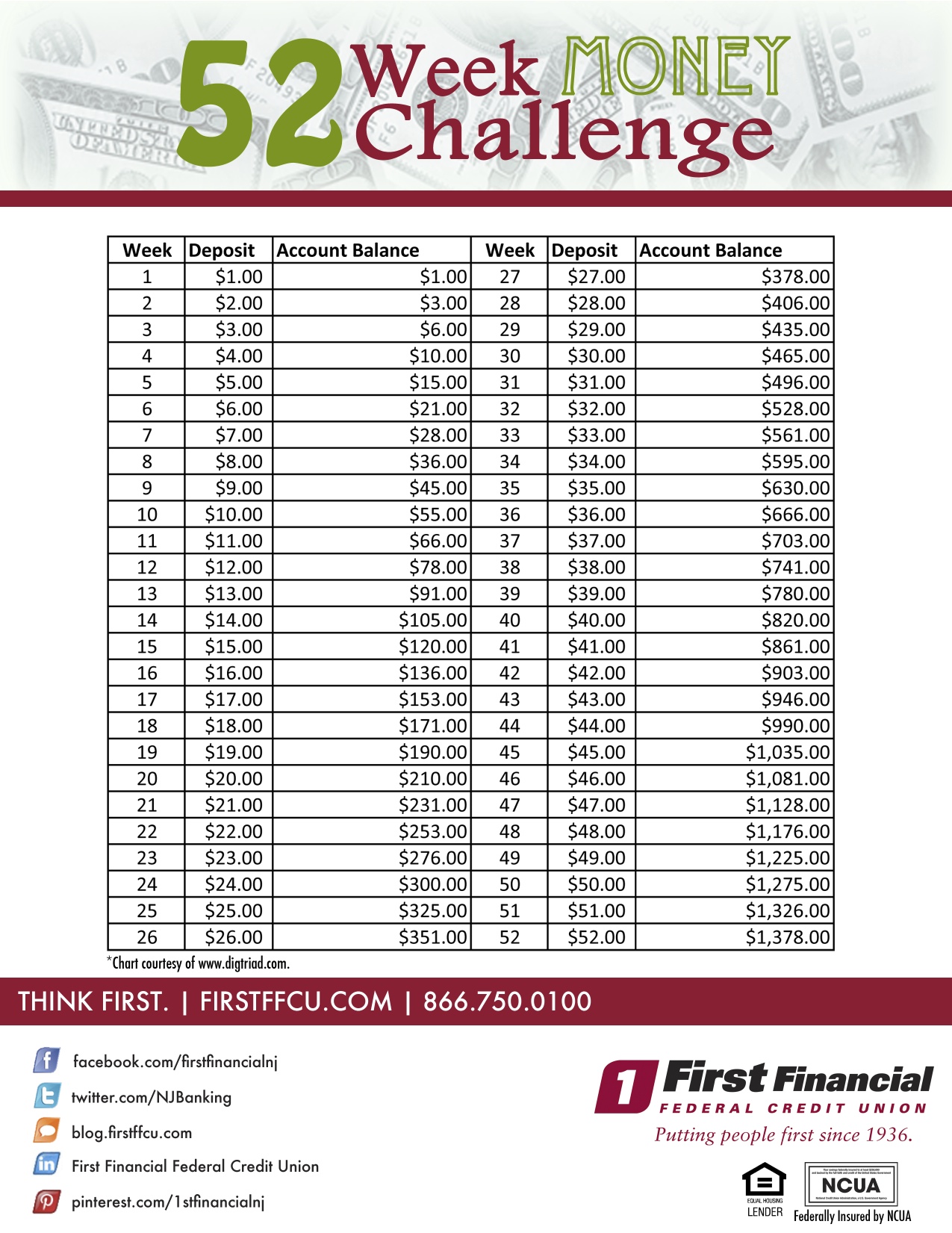
52 Week Savings Challenge

Start your new year off the right way – by saving money.  Take the 52 week money challenge below, and you’re guaranteed to save almost $1,400 by the start of the new year. Ready, set, go!

52WeekMoneyChallenge JPEG