No Tax on Tips Deduction Explained

With the enactment of the One Big Beautiful Bill Act in July 2025, a new deduction for tips is effective for tax years 2025 through 2028. Here is a summary of the new provision and the occupations that will be affected.

Deduction explained

Employees and self-employed individuals may deduct up to $25,000 per year of qualified tips, provided they work in an occupation the IRS views as “customarily and regularly” receiving tips on or before December 31, 2024. This deduction is available to taxpayers whether they claim the standard deduction or itemize.

Qualified tips include voluntary cash or card payments, whether given directly by customers or through tip sharing. Tips must be voluntary and do not include automatic gratuities and mandatory service charges. For self-employed individuals, the deduction cannot exceed their net income (before applying the deduction) from the business in which the tips were earned.

Eligibility details

  • Taxpayers claiming the deduction must provide their Social Security number.
  • Married couples must file jointly.
  • Married couples filing separately are not eligible.
  • Workers in excluded fields, such as health, performing arts, or athletics (and their employees), are ineligible.
  • Employers must report tips and occupation details annually to the IRS or Social Security Administration and provide statements to workers.
  • The total amount of qualified tips that can be deducted per calendar year is $25,000 regardless of filing status.

Deduction limitations

The deduction begins to phase out for single filers with Modified Adjusted Gross Income (MAGI) over $150,000 or over $300,000 for married couples filing jointly. The deduction is reduced by $100 for every $1,000 above these thresholds.

Qualifying jobs

In October 2025, the U.S. Department of the Treasury and the IRS published proposed rules listing the industries and occupations that qualify for the deduction, because tipping was customary and regular in these jobs before December 31, 2024. Here are the qualifying industries with some of the most common qualifying occupations.

  • Beverage and food service: Bartenders, wait staff, baristas, bussers, cooks, dishwashers, hosts, and bakers
  • Entertainment and events: Casino dealers, musicians, DJs, performers, ushers, ticket takers, and digital content creators
  • Hospitality and guest services: Bellhops, concierges, hotel desk clerks, and housekeepers
  • Home services: Cleaners, plumbers, electricians, landscapers, HVAC repair workers, and locksmiths
  • Personal services: Nannies, babysitters, tutors, pet sitters, photographers, event planners, and personal caregivers
  • Personal appearance and wellness: Hairdressers, barbers, massage therapists, nail technicians, estheticians, and tattoo artists
  • Recreation and instruction: Golf caddies, tour guides, fitness instructors, self-enrichment teachers, and recreational pilots
  • Transportation and delivery: Valets, taxi/rideshare drivers, shuttle drivers, delivery workers, charter boat staff, car detailers, and home movers

A detailed list of occupations can be found on the website of the Federal Register.

Workers in up to 68 occupations could see their tax burden reduced by the “no tax on tips” deduction.

IRS transition relief

For tax year 2025, the IRS will provide transition relief in the form of further guidance or additional time for qualified taxpayers and employers to adapt to the new reporting requirements.

The “no tax on tips” deduction will likely affect many tipped workers in the hospitality, food service, personal care, delivery, and other industries. Both taxpayers and employers should stay updated on all reporting changes and compliance requirements.

Questions about this topic? Contact First Financial’s Investment & Retirement Center by calling 732.312.1534.  You can also email mary.laferriere@lpl.com or maureen.mcgreevy@lpl.com

Securities and advisory services are offered through LPL Financial (LPL), a registered investment advisor and broker/dealer (member FINRA/SIPC). Insurance products are offered through LPL or its licensed affiliates. First Financial Federal Credit Union (FFFCU) and First Financial Investment & Retirement Center are not registered as a broker/dealer or investment advisor. Registered representatives of LPL offer products and services using First Financial Investment & Retirement Center, and may also be employees of FFFCU. These products and services are being offered through LPL or its affiliates, which are separate entities from and not affiliates of FFFCU or First Financial Investment & Retirement Center.

Securities and insurance offered through LPL or its affiliates are:

The information provided is not intended to be a substitute for specific individualized tax planning or legal advice. We suggest that you consult with a qualified tax or legal professional.

LPL Financial Representatives offer access to Trust Services through The Private Trust Company N.A., an affiliate of LPL Financial.

Content in this material is for general information only and not intended to provide specific advice or recommendations for any individual. All performance referenced is historical and is no guarantee of future results. All indices are unmanaged and may not be invested into directly.

CRPC conferred by College for Financial Planning.

This communication is strictly intended for individuals residing in the state(s) of CT, DE, FL, GA, MA, NJ, NY, NC, OR, PA, SC, TN and VA. No offers may be made or accepted from any resident outside the specific states referenced.

Prepared by Broadridge Advisor Solutions Copyright 2025.

Balancing Life in the Sandwich Generation

Are you a middle-aged adult juggling raising children and providing care for an aging parent? If so, you’re not alone. Welcome to the “sandwich generation,” a growing group of people supporting both their children and elderly parents at the same time.

While caring for others can be rewarding, the day-to-day demands of supporting multiple generations can take a financial, emotional, and physical toll on sandwiched caregivers. But with some planning and support, you may be able to achieve a workable balance.

Communicate and set boundaries

Start by opening the lines of communication with both your kids and your parents in order to set expectations and limitations. If you have younger children, you may need to explain to them why you need to divide your time and attention between them and your parents. To help them feel included, look for ways to involve them in less difficult caregiving activities, such as visiting with their grandparents or helping out with household chores. You’ll also want to try to build time into your schedule to do some of the activities that they enjoy.

When talking to your parents, having an upfront and honest discussion about their day-to-day support needs and your ability to meet them – can prevent misunderstandings down the road. When the time comes, you may need to discuss more sensitive topics such as the possibility of having them move to an assisted-living facility, a nursing home, or dedicated space in your home.

If you have siblings or other family members willing to help, set up regular family meetings to discuss how you can all share in the financial, emotional, and time commitments of caregiving.

Leverage community resources

It’s important to realize that you don’t have to carry the burden of caregiving alone. Contact your local senior center – which can provide information on meal delivery services, transportation assistance, adult day programs, and even respite care.

If your parents’ needs are great enough, you might consider hiring a geriatric care manager who can develop a personalized care plan for them. They can also make recommendations for and help coordinate services, housing, and support.

If you need childcare, explore local resources and referral agencies to help you find licensed childcare providers. Contact your children’s school and/or local parks and recreation departments regarding sports leagues, before and after school programs, and/or summer camps.

Prioritize self-care

Putting your own needs first will allow you to be in a better frame of mind to care for those around you. Try to set aside time to rest and recharge your batteries. Even small daily rituals — a walk, exercise class, or meditation — can provide much needed relief.

Your physical and mental health should also be a priority. Stay on top of your own medical appointments and don’t hesitate to seek out counseling if the demands of caregiving become too great.

Explore flexible or remote work arrangements

Nearly 48 million Americans provide care to an adult family member or friend, and 61% also have jobs.1 Talk to your employer about the possibility of flexible or remote work arrangements. Being transparent with your employer about your caregiving responsibilities can help build understanding and possibly lead to creative work solutions that can help alleviate some of the pressures of working while caregiving.

In addition, research the family medical leave options available to you. While the Family and Medical Leave Act (FMLA) provides some protections, your state or company may offer additional benefits.

Stay on track with your finances

When you are busy taking care of others, it is easy to fall behind financially. In addition to being responsible for your children’s financial needs, you may also find yourself shouldering some of your parents’ financial responsibilities. Nevertheless, it’s important to stay on track with your own finances. This includes sticking to your budget, paying off debt, maintaining an emergency fund, and continuing to invest toward your retirement.

Questions about this topic or need help planning your financial future? Contact First Financial’s Investment & Retirement Center by calling 732.312.1534. You can also email mary.laferriere@lpl.com or maureen.mcgreevy@lpl.com

Securities and advisory services are offered through LPL Financial (LPL), a registered investment advisor and broker/dealer (member FINRA/SIPC). Insurance products are offered through LPL or its licensed affiliates. First Financial Federal Credit Union (FFFCU) and First Financial Investment & Retirement Center are not registered as a broker/dealer or investment advisor. Registered representatives of LPL offer products and services using First Financial Investment & Retirement Center, and may also be employees of FFFCU. These products and services are being offered through LPL or its affiliates, which are separate entities from and not affiliates of FFFCU or First Financial Investment & Retirement Center.

Securities and insurance offered through LPL or its affiliates are:

The information provided is not intended to be a substitute for specific individualized tax planning or legal advice. We suggest that you consult with a qualified tax or legal professional. LPL Financial Representatives offer access to Trust Services through The Private Trust Company N.A., an affiliate of LPL Financial. Content in this material is for general information only and not intended to provide specific advice or recommendations for any individual. All performance referenced is historical and is no guarantee of future results. All indices are unmanaged and may not be invested into directly. CRPC conferred by College for Financial Planning. This communication is strictly intended for individuals residing in the state(s) of CT, DE, FL, GA, MA, NJ, NY, NC, OR, PA, SC, TN and VA. No offers may be made or accepted from any resident outside the specific states referenced.

1) AARP and S&P Global, May 2024

Prepared by Broadridge Advisor Solutions Copyright 2025.

Finish the Year Strong by Considering These Tax Moves

As 2025 comes to a close, now may be the ideal time to review your tax strategy and find potential opportunities. The steps you take before the end of the year might help you reduce your tax bill. Here are some ideas to consider.

Save now, have more later: If you’re participating in an employer-sponsored 401(k) or 403(b) plan, think about contributing the full pre-tax amount allowed to your retirement accounts by the end of the year. For 2025, the annual limit is $23,500 ($31,000 if you’re age 50 to 59 or 64 and older; $34,750 if you turn age 60, 61, 62, or 63 during the year). If you have a traditional or Roth IRA, you can contribute up to $7,000 for 2025, $8,000 if you’re age 50 or older.1 Traditional IRA contributions may be deductible, but Roth contributions are not.

Time it right, defer or accelerate income: If you expect a significant change in your income from one year to the next — for example, due to a bonus or investment gains — consider deferring or accelerating income. If you expect to be in a lower tax bracket next year, you may benefit from deferring some income into 2026 when it may be taxed at a lower rate. But, if you expect to be in a higher tax bracket next year, accelerating income in 2025 may help reduce your tax liability by taking advantage of your current rate. Timing matters when you’re close to a threshold that impacts tax rates, credits, or deductions.

Hold on for better rates: Holding your investments longer may help reduce your tax bill. If you have stocks or other assets that have appreciated in value, keeping the asset for more than a year means you are typically subject to long-term rates of 0%, 15%, or 20% on any capital gains from a sale (based on your income tax bracket). If you sell the asset earlier than this, your gains are generally taxed at ordinary income tax rates, which may be higher.

Harvest your losses: If you experience capital losses on securities and no longer want to hold the securities in your portfolio, consider selling these underperformers to offset gains from other investments. Losses above the amount of your gains can offset up to $3,000 of ordinary income ($1,500 if your filing status is married filing separately). Unused losses can be carried forward to future years. Watch out for the wash-sale rule, which precludes taking a capital loss deduction if you repurchase the same investment within 30 days before or after selling it.

Save today for your future health costs: Whether you have a health savings account (HSA) through your employer or one you’ve opened individually, contributing more now can help reduce your tax bill. You can boost your HSA savings by increasing payroll deductions or by making direct contributions to your account. For 2025, the contribution limits are $4,300 for individual coverage and $8,550 for family coverage (contributions made by you and your employer count toward this limit). Contributions made through payroll deductions help reduce your taxable income, and contributions made outside of payroll deductions are tax deductible.2

Give more, pay less: If you itemize deductions on your federal income tax return, you can generally deduct charitable contributions, but the deduction is limited to 50% (60% for cash contributions to public charities), 30%, or 20% of your adjusted gross income, depending on the type of property you give and the type of organization to which you contribute. Excess amounts can be carried over for up to five years.

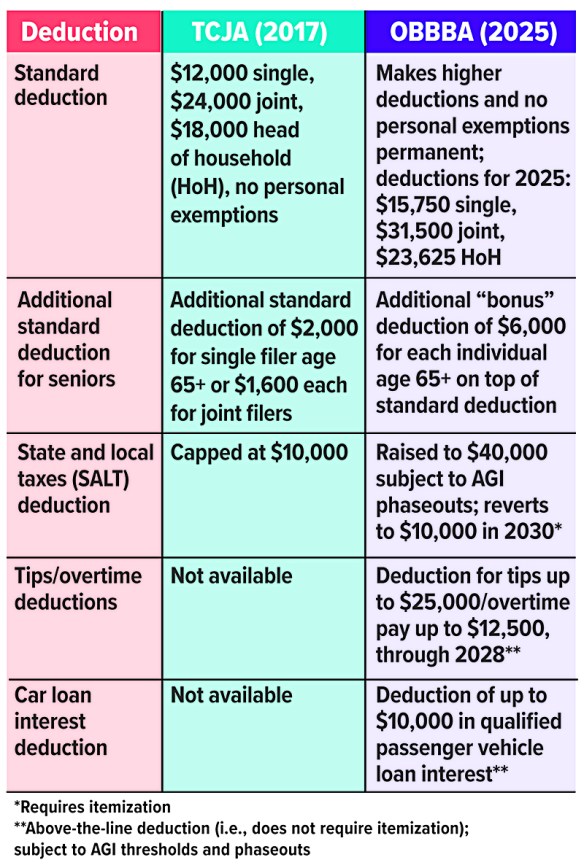
New Deductions

This chart compares some major deductions from the 2017 Tax Cuts and Jobs Act (TCJA) with updates in the One Big Beautiful Bill Act (OBBBA), signed into law on July 4, 2025, and effective for the 2025 tax year.

Questions about this topic? Contact First Financial’s Investment & Retirement Center by calling 732.312.1534. You can also email mary.laferriere@lpl.com or maureen.mcgreevy@lpl.com

Securities and advisory services are offered through LPL Financial (LPL), a registered investment advisor and broker/dealer (member FINRA/SIPC). Insurance products are offered through LPL or its licensed affiliates. First Financial Federal Credit Union (FFFCU) and First Financial Investment & Retirement Center are not registered as a broker/dealer or investment advisor. Registered representatives of LPL offer products and services using First Financial Investment & Retirement Center, and may also be employees of FFFCU. These products and services are being offered through LPL or its affiliates, which are separate entities from and not affiliates of FFFCU or First Financial Investment & Retirement Center.

Securities and insurance offered through LPL or its affiliates are:

The information provided is not intended to be a substitute for specific individualized tax planning or legal advice. We suggest that you consult with a qualified tax or legal professional. LPL Financial Representatives offer access to Trust Services through The Private Trust Company N.A., an affiliate of LPL Financial. Content in this material is for general information only and not intended to provide specific advice or recommendations for any individual. All performance referenced is historical and is no guarantee of future results. All indices are unmanaged and may not be invested into directly. CRPC conferred by College for Financial Planning. This communication is strictly intended for individuals residing in the state(s) of CT, DE, FL, GA, MA, NJ, NY, NC, OR, PA, SC, TN and VA. No offers may be made or accepted from any resident outside the specific states referenced.

1–2) 2025 IRA and HSA contributions can be made up to April 15, 2026.

Prepared by Broadridge Advisor Solutions Copyright 2025.

Retire with a Spending Plan

Do you have a spending plan in place for when you retire? Many retirees worry about outliving their money. It’s important to have a strategy for withdrawing and using your retirement assets.

First, you’ll need to determine a practical, yearly withdrawal amount. Some households adopt the 4% rule, which entails removing 4% from their savings annually. That rule, however, has its critics, many of whom feel it can backfire in a volatile market. Some retirees try to withdraw a set dollar amount annually. Others withdraw a fixed percentage of their portfolio or aim to live off its interest rather than its principal. There is also the “bucket” approach, in which a retiree withdraws cash to live on from an account that would be “refilled” with investment earnings from other accounts.

Second, keep in mind the order in which you withdraw from your accounts. It may be preferable to withdraw income from your taxable investment accounts first. That way, you can give your tax-deferred accounts a chance to grow and compound further. Generally, withdrawals from tax-deferred retirement accounts are required at age 72. Because the taxable income resulting from these mandatory withdrawals may put you in a higher tax bracket, one option is to start allowing withdrawals from these accounts earlier (after age 59 1/2) – the smaller the account balance, the smaller the mandatory withdrawal becomes.

As your retirement progresses, you’ll want to review your strategy. Life events, investment returns, inflation and other factors may call for adjustments. The key is to have a plan in place that you can then modify as needed.

Contact us today to learn more about developing a savings strategy that’s right for you.

Questions about this topic? Contact First Financial’s Investment & Retirement Center by calling 732.312.1534.  You can also email mary.laferriere@lpl.com or maureen.mcgreevy@lpl.com

Securities and advisory services are offered through LPL Financial (LPL), a registered investment advisor and broker/dealer (member FINRA/SIPC). Insurance products are offered through LPL or its licensed affiliates. First Financial Federal Credit Union (FFFCU) and First Financial Investment & Retirement Center are not registered as a broker/dealer or investment advisor. Registered representatives of LPL offer products and services using First Financial Investment & Retirement Center, and may also be employees of FFFCU. These products and services are being offered through LPL or its affiliates, which are separate entities from and not affiliates of FFFCU or First Financial Investment & Retirement Center.

Securities and insurance offered through LPL or its affiliates are:

This material is for general information only and is not intended to provide specific advice or recommendations for any individual. There is no assurance that the views or strategies discussed are suitable for all investors or will yield positive outcomes. Investing involves risks including possible loss of principal.

This material was prepared by LPL Financial, LLC

Tracking #485871

The Differences Between a Will, Living Will, Trust, and Power of Attorney

In addition to a power of attorney, there are several other documents that are critical to consider when getting your estate in order. Estate planning is the process of designating who will receive your assets and handle your responsibilities after your death or incapacitation. The main benefit of estate planning is that it ensures your wishes are carried out when you are no longer able to do so, making you feel more organized and confident that your loved ones won’t be unnecessarily burdened in the future. We will discuss some of the potential benefits of specific documents that can be included in an estate plan, such as a will, living will, and trust – as well as revisit some of the benefits of a power of attorney.

Wills

A Will is a legal document that outlines how you’d like your assets distributed after your death. It allows you to name an executor who will manage your estate, pay any debt and distribute your assets. You can also designate guardians for minor children. For business owners, a will can help successfully and efficiently transition assets.

A main benefit of a will is that although it does not avoid the probate process, it can make things much easier. Legally speaking, anything that speeds up the process of physical asset distribution can minimize fees and make things easier for everyone involved. It can also eliminate any potential family disputes over who gets which assets. However, it’s important to remember that a will is only a roadmap. It’s best to make sure that all of your financial assets and valuable possessions (like a home or a car) have beneficiaries named in other documents besides the will.

Living Wills

A living will, also known as an advanced healthcare directive, states your wishes regarding life-prolonging medical treatments. It comes into play only when an individual faces a life-threatening condition and is unable to communicate their desires for treatment.

One of the main benefits of a living will is that it speaks for you when you become incapacitated or unable to communicate – it states your desires for medical treatment if you are unable to make those decisions yourself. Without a living will, decisions regarding medical care become the responsibility of a spouse, family members, or other third parties. These individuals may be unaware of your desires if they are unwritten.1

Trusts

A trust is a legal entity that can “own” assets. The document looks much like a will, and includes instructions for who is to handle final affairs and who is to receive the deceased’s assets. There are many types of trusts.

Today, many people use a revocable living trust instead of a will in their estate plan because of this benefit – it avoids court interference at death and at incapacity. For a living trust to work properly, you must transfer your assets into it. Titles must be changed from your “individual” name to the name of your trust. Because your name is no longer on any titles, there is no reason for the court to get involved if you become incapacitated or when you pass away. This makes it easy for a trustee or successor trustee, to step in and manage your financial affairs. Another benefit of a trust is that it is private, whereas a will is not because it goes into public records.

Power of Attorney

Typically, a power of attorney (POA) is a document that authorizes someone to handle financial and some legal decisions when you become incapacitated. Anyone you trust, such as a family member or friend, can serve in this role for you. You can even designate more than one person, assigning different responsibilities to each.

It’s important to have a power of attorney, because it will allow the person you assign to act on your behalf when you are unable to do so yourself. Without a power of attorney, a court may be left to decide what happens to your assets if you are found to be mentally incompetent, and the court’s decision may not be what you intended. A POA can give your agent the power to transact real estate, perform financial transactions, and make other legal decisions as if he or she were you. It’s important to reiterate that you assign this person – meaning you can select a person whom you believe will be able to carry out your wishes and ensure your affairs are kept in order.

Estate plans are not “one-size-fits-all.” It is up to you to determine which components are best for you and your loved ones. Although it might feel overwhelming, starting with one or many of these items will give you peace of mind in knowing you have taken the first step to creating your estate plan.

Should you be thinking about your financial future and retirement, as well as estate planning – the First Financial Investment & Retirement Center will be hosting an exclusive no-cost virtual seminar on the Transitions to Retirement featuring a bonus segment on Estate Planning, on Wednesday, October 8th at 6pm.

(697533-1 and 622155)

You can register for this session from the link above or by contacting Maureen McGreevy, LPL Financial Advisor at 732.312.1534 or emailing maureen.mcgreevy@lplfinancial.com

Securities and advisory services are offered through LPL Financial (LPL), a registered investment advisor and broker/dealer (member FINRA/SIPC). Insurance products are offered through LPL or its licensed affiliates. First Financial Federal Credit Union (FFFCU) and First Financial Investment & Retirement Center are not registered as a broker/dealer or investment advisor. Registered representatives of LPL offer products and services using First Financial Investment & Retirement Center, and may also be employees of FFFCU. These products and services are being offered through LPL or its affiliates, which are separate entities from and not affiliates of FFFCU or First Financial Investment & Retirement Center.

Securities and insurance offered through LPL or its affiliates are:

This information is not intended to be a substitute for individualized legal advice or estate planning advice. Please consult your legal or estate planning advisor regarding your specific situation.

Sources:

  1. Investopedia.com, February 17, 2025

LPL tracking #’s referenced: 1-05375681, 676252, 653950, 513868

How to Detect and Prevent Power of Attorney Fraud

Along with the potential benefits associated with establishing a power of attorney, come potential risks to consider. Our first article in this series discussed what a power of attorney (POA) is – a legal document that ensures your wishes (typically having to do with your assets), are carried out in a manner that you as the principal approve of. It gives a trusted person (often referred to as an agent), the legal authority to handle these wishes. Anyone you trust – such as a family member or friend, can serve in this role for you.

Even when designating someone you trust as your POA, the risk of fraud and abuse can still exist. This person may perform actions that the POA document does not authorize, manipulate you or your assets for their own personal gain, or not act in your best interest.1

There are several ways in which POA fraud and abuse can occur, so it is best to become familiar with some of them so you can recognize if it may be happening to you or someone you care about.

Financial Exploitation: In this instance, the agent may use the principal’s money for their own gain instead of the principal’s needs – often without informing the principal. They may withdraw funds from the principal’s accounts for their own use or conceal the reason for withdrawing the funds. They may justify an expenditure by saying it was for the principal’s benefit, but then use the funds for something that does not align with the principal’s needs or wishes.2

Unauthorized Gifting: This occurrence happens when the agent authorizes gifts to themselves or other family members without the authority to do so, without the principal’s knowledge, or without considering if it is in the principal’s best interest. Gifting is unauthorized if the POA does not explicitly authorize gifting, which can include recipients and the dollar amount(s) that may be gifted.3 If gifting is authorized – the agent should consider the principal’s entire financial situation, upcoming financial obligations, and if it is consistent with their personal character. 3

Neglect of Duties: Neglect occurs when the agent does not provide care as required by the POA – such as meeting medical needs or providing adequate living conditions. 2 This can also take the form of neglecting financial responsibilities, such as not paying bills.

What are common red flags of POA fraud?

  • Bills are unpaid, even though there should be sufficient funds to pay them. This can suggest that the agent is using the funds for unauthorized purposes or neglecting to manage the principal’s financial obligations.
  • Sudden, unexplained changes to legal documents. Especially if the changes benefit the agent, or if the principal is unaware of or didn’t consent to the changes.2
  • Information is being withheld from the principal and principal’s loved ones. The agent may avoid answering questions or giving information about the principal’s financial situation, including their bank accounts or investments.4
  • The principal becomes isolated from loved ones. The agent may isolate the principal from those who care about them so that it is harder to detect if something is not right. Isolating the principal also allows the agent to exercise more control, without the potential for others to intervene. 2

How can you protect yourself from POA fraud and abuse?

  • Choose your agent wisely. Choosing an agent that you trust, and whose values align with your own, to ensure they are capable of following your wishes and putting your needs first.2
  • Specify the scope of the POA. Clearly defining tasks, responsibilities, and decisions to be made on your behalf can minimize the potential for abuse.2 This aligns the power that is legally granted with your intentions, and only gives the agent the authority needed to carry out your wishes.
  • Clearly communicate with your agent. Continually check in with your agent to confirm your wishes and preferences. Promptly make any changes you desire to the POA so that the agent remains aligned with your wishes.
  • Inform trusted individuals about your POA. By informing trusted individuals such as family, friends, and business partners about your POA – they can be on the lookout for any red flags that signal fraud or abuse.
  • If possible, remain involved in decision-making. Review the agent’s activity, such as any financial transactions they are conducting or any medical decisions they are making on your behalf. This encourages transparency between you and the agent and keeps you involved in your affairs, to the degree you wish to be. 2

To report POA fraud, contact Adult Protective Services (APS) in your state or to the National Center on Elder Abuse (NCEA). Any identity theft incidents related to fraud should be reported to the principal’s financial institution, the local police, and to the Federal Trade Commission at identitytheft.gov.

If you are thinking about your financial future and retirement, as well as estate planning – the First Financial Investment & Retirement Center will be hosting an exclusive no-cost virtual seminar on the Transitions to Retirement with a Focus on Estate Planning, on Wednesday, October 8th at 6pm.

(697533-1 and 622155)

You can also register for this session by contacting Maureen McGreevy, LPL Financial Advisor at 732.312.1534 or emailing maureen.mcgreevy@lplfinancial.com

Securities and advisory services are offered through LPL Financial (LPL), a registered investment advisor and broker/dealer (member FINRA/SIPC). Insurance products are offered through LPL or its licensed affiliates. First Financial Federal Credit Union (FFFCU) and First Financial Investment & Retirement Center are not registered as a broker/dealer or investment advisor. Registered representatives of LPL offer products and services using First Financial Investment & Retirement Center, and may also be employees of FFFCU. These products and services are being offered through LPL or its affiliates, which are separate entities from and not affiliates of FFFCU or First Financial Investment & Retirement Center.

Securities and insurance offered through LPL or its affiliates are:

This material is for general information only and is not intended to provide specific advice or recommendations for any individual. For individual estate planning advice, consult with an estate attorney.

  1. John Lewandowski of Heban Murphree Lewandowski Law, March 12, 2022
    1. What Is Considered Power of Attorney Abuse? | HML Law
  2. Edward Gates for American Judicial System, October 10, 2023
    1. How Do You Prove Power Of Attorney Abuse: Steps and Strategies for Justice
  3. National Research Legal Group, Inc., June 19, 2019
    1. ESTATES: Gifts Under a Power of Attorney
  4. Mark R. Manceri, P.A., June 9, 2023
    1. 6 Warning Signs That Power Of Attorney May Be Abused